

Candle Warning Label Requirements: What To Include (US)
Every candle you sell needs a label that does more than look good, it needs to meet candle warning label requirements set by federal and industry standards. Skip them, and you risk fines, pulled products, or worse, someone getting hurt. These aren't optional extras. They're legal obligations that protect both your customers and your business.
At Small Flame Candle Company, we hand-pour every candle we sell, which means we've had to learn these rules inside and out. From fire safety warnings to proper weight disclosures, labeling is part of the craft, not an afterthought. We put this guide together based on what we've learned through direct experience bringing our own products to market.
Below, you'll find a plain-English breakdown of what U.S. candle labels must include, which standards apply, and how to make sure your labels are compliant before you start selling.
Why candle warning labels matter
Candles are open-flame products, and that distinction matters more than most sellers realize. Burns, fires, and toxic fume exposure are documented outcomes when candles are misused, and regulators have built a framework around reducing those risks. Meeting candle warning label requirements isn't just about paperwork; it's about making sure your customers use your product safely and that your business doesn't face avoidable consequences.
The safety risk is real
According to the U.S. Fire Administration, candles are one of the leading causes of residential fires in the country. Most of those fires trace back to human error: leaving candles unattended, burning them too close to flammable materials, or running them well past the point where the container can safely handle the heat. Warning labels exist to interrupt those habits by putting direct, clear instructions in front of the customer at the moment they're holding the product.
A warning label is the last line of communication between you and your customer before they light the wick.
Your label tells buyers to keep wicks trimmed and to never leave a burning candle unattended. Those aren't suggestions. They're the minimum information your customer needs to use your product without incident, and they carry real weight when something goes wrong.
Legal and financial consequences
Skipping proper labels opens you up to genuine liability. If a customer is injured while using your candle and your product lacked required warnings, you have very little legal ground to stand on. That exposure includes potential lawsuits, product recalls, and removal from sales platforms if you distribute through retailers or online marketplaces.
Wholesale buyers and retail partners also review label compliance before agreeing to stock a product. If your candles don't meet the expected safety and disclosure standards, you lose those channels before you ever get a foot in the door. For a small maker, that's not a minor setback. Getting your labels right at the start protects your customers and keeps your business on solid footing.
What US rules and standards apply
No single federal law covers every aspect of candle warning label requirements, but several overlapping rules and standards apply to what you put on your label. You need to understand all of them, not just one, because compliance means satisfying multiple authorities at once.
ASTM International standards
ASTM International publishes two key standards for candle makers. ASTM F2601 covers fire safety labeling specifically, defining the exact warning language and symbols your label must carry. ASTM F2417 addresses candle fire safety more broadly, including container requirements and wick specifications. These standards are technically voluntary, but retail partners and major marketplaces treat them as mandatory. If your candles don't meet ASTM requirements, expect friction when you try to sell through any established channel.
Meeting ASTM standards is the baseline expectation, not a bonus feature, for any candle sold commercially in the US.
Federal regulations
The Consumer Product Safety Commission (CPSC) has authority to act on candle products that pose unreasonable risks, which means non-compliant labels can trigger enforcement action. Beyond that, the Fair Packaging and Labeling Act (FPLA), enforced by the FTC, requires you to disclose net weight, your business name, and your place of business on the package.
These aren't industry-specific rules; they apply to any consumer product you sell in the United States. Together, ASTM standards and federal law form the complete framework your labels need to satisfy before your candles reach a customer.
How to build a compliant candle label
Building a compliant label starts with understanding that every element on your label has a job to do. Some elements satisfy federal disclosure rules, others meet candle warning label requirements from ASTM standards, and some handle both. Treating your label as a checklist keeps you from missing critical information during the design process.
Start with the required information blocks
Your label needs to carry several distinct blocks of information. Net weight in both ounces and grams goes on the front panel per FPLA rules, and your business name and place of business must also appear so consumers and regulators can identify the product source.
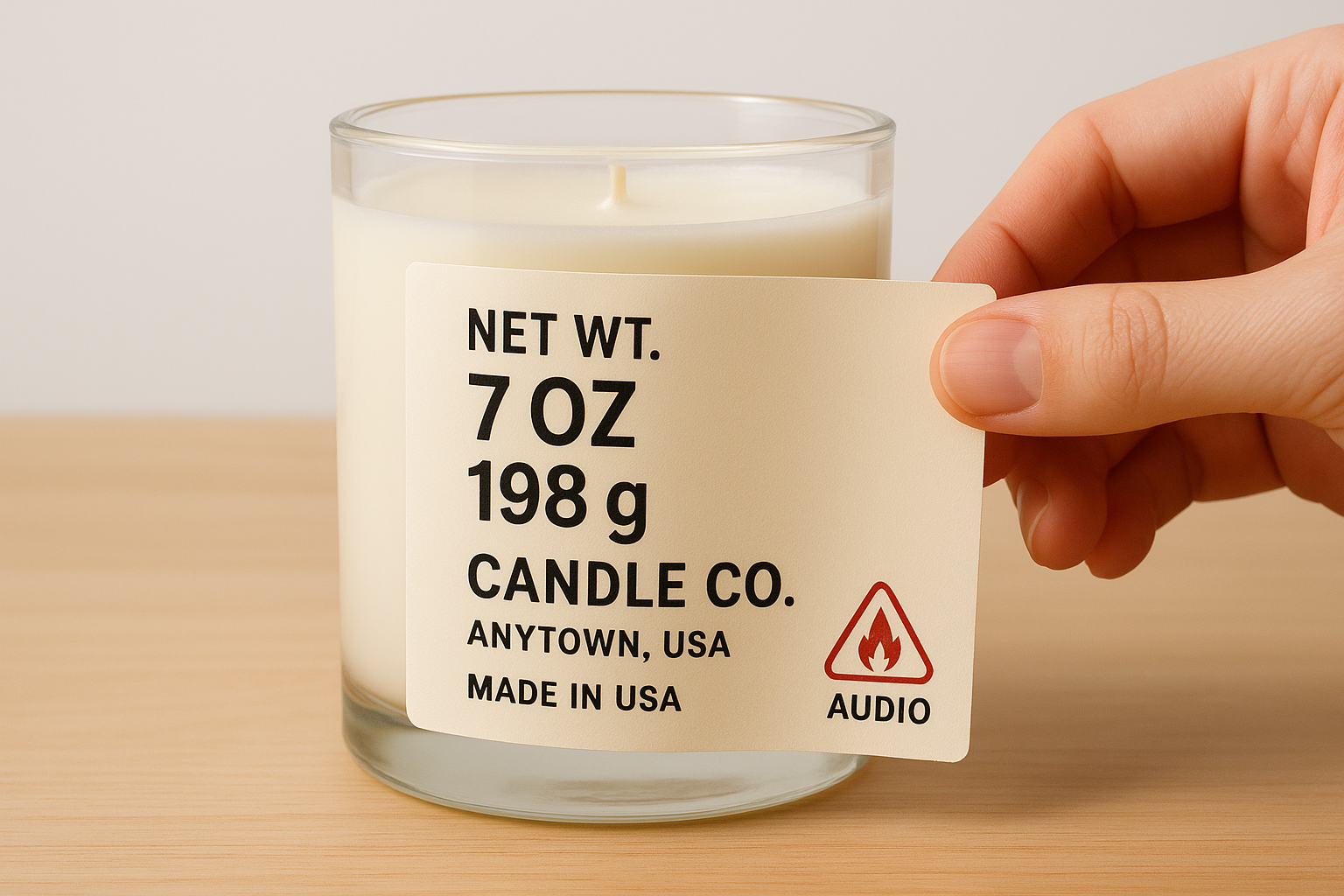
Getting these foundational blocks in place before you work on aesthetics keeps your design process cleaner and reduces the chance of missing something critical.
Required label blocks include:
- Net weight (in US customary and metric units)
- Business name and address
- Country of origin if applicable
- Fire safety warnings and symbols
- Burn time if claimed on the label
Design around legibility
Warning text needs to be clearly readable under normal retail conditions, which means adequate font size and sufficient contrast between text and background. The ASTM F2601 standard specifies that warning language must be conspicuous and in English, so decorative fonts and low-contrast color pairings create compliance problems, not just aesthetic ones.
Choose a label size that gives your warning block enough breathing room to remain easy to read. Cramped or overlapping text undermines the entire purpose of the warning and draws scrutiny from retail buyers reviewing your products.
Required text and symbols for warning labels
The ASTM F2601 standard defines the exact warning text your label must carry, and you cannot paraphrase it or write your own version. Using the approved language word-for-word is what makes your label compliant, and any deviation puts you outside the standard.
The required warning phrases
ASTM F2601 requires specific phrases that must appear on every candle you sell. Your label must include all of the following:
- Never leave a burning candle unattended.
- Keep away from flammable materials.
- Keep away from children and pets.
- Burn candle within sight.
- Trim wick to 1/4 inch before lighting.
- Stop use when only 1/2 inch of wax remains.
These phrases form the core candle warning label requirements, and they must appear as a complete block, not scattered across different parts of the label.
The warning symbol
Beyond text, ASTM F2601 also requires a specific warning symbol on your label: a flame icon accompanied by the word "WARNING" in capital letters. You must place this symbol directly above or adjacent to the warning text block to stay within the standard. The icon communicates the hazard visually before a customer reads a single word, which is exactly why regulators require it.
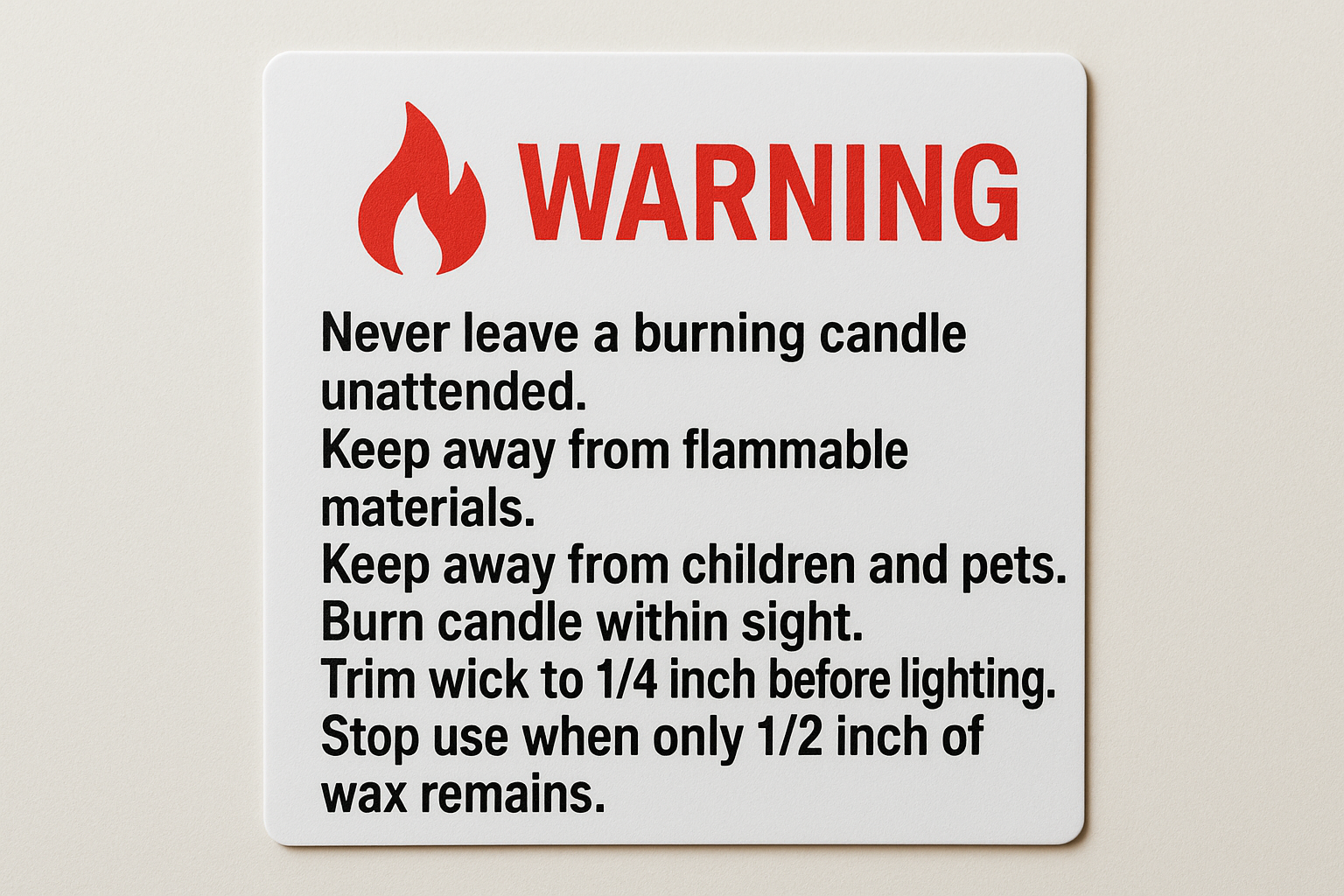
Leaving off the warning symbol is one of the most common compliance mistakes small candle makers make, and fixing it requires nothing more than updating your label file.
Where to place labels and how to format them
Label placement is not arbitrary. Where you put your warning block and how you format it directly affects whether your label satisfies candle warning label requirements and whether a customer actually reads it before lighting the wick.
Bottom placement is the standard
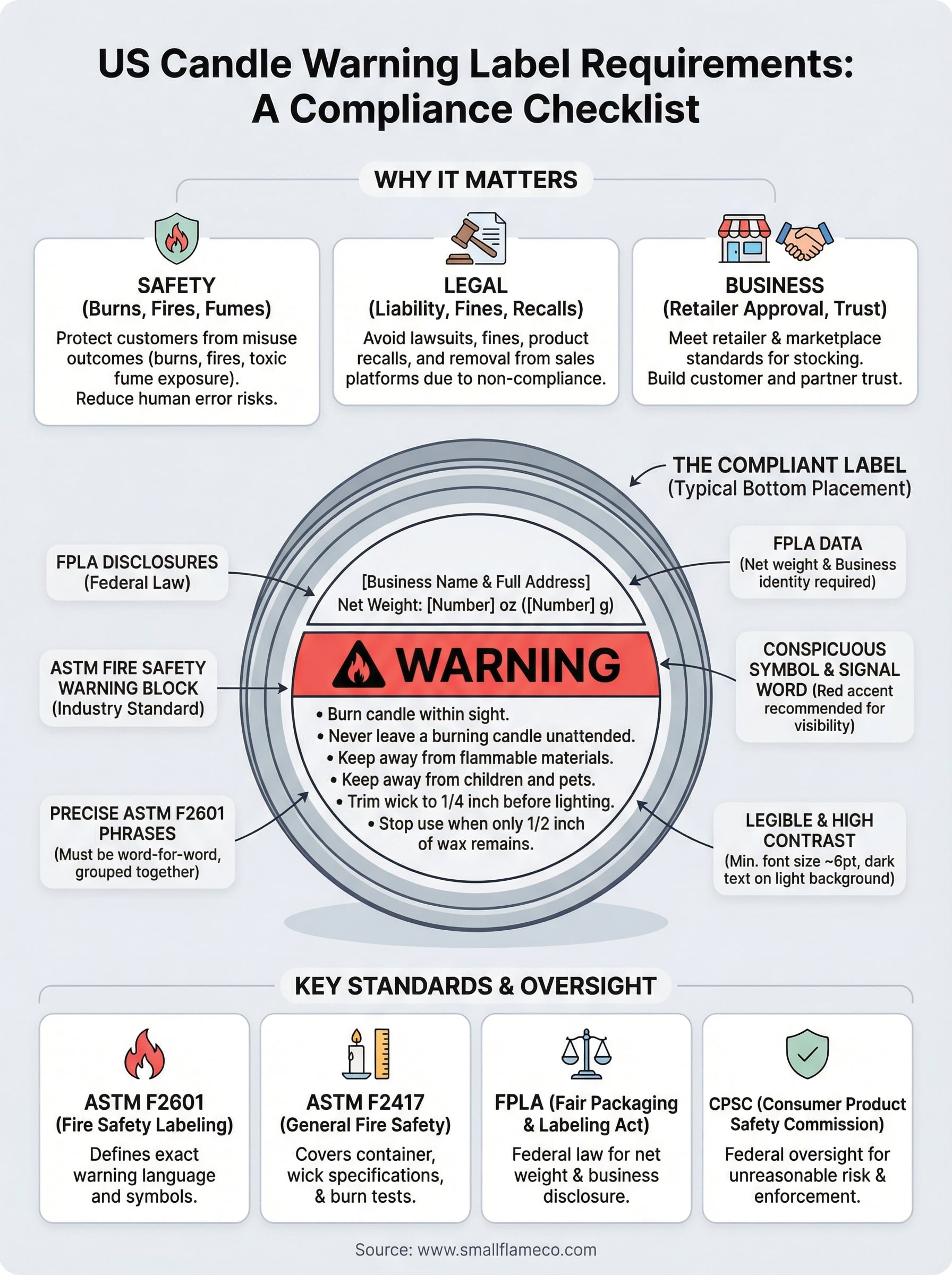
Most candle makers place the warning label on the bottom of the container, which keeps the product's exterior clean while still meeting compliance standards. This works for jar candles and tins, where the base offers a flat, readable surface. If your container design makes bottom placement impractical, you can use a secondary side label, but the warning block must remain fully visible and unobstructed when the candle is sitting in a normal retail position.
Burying your warning text under a decorative sleeve or ribbon is a compliance failure, even if the text technically exists on the label underneath.
Font size and contrast requirements
Your warning text needs to be legible without effort, which means a minimum font size that reads clearly under typical lighting conditions. Most compliant labels use at least 6-point type for warning blocks, though larger is better for readability. Beyond size, the contrast between your text color and background matters just as much. Dark text on a light background is the safest approach and avoids any ambiguity about whether the text meets conspicuousness standards. Avoid decorative or script fonts for warning copy since they slow reading and create compliance risk.
Next steps
You now have everything you need to build a label that satisfies candle warning label requirements under both ASTM standards and federal law. Start by auditing any labels you already use. Check for the required ASTM F2601 warning phrases, the flame symbol, net weight disclosure, and your business name and address. If any of those elements are missing or formatted incorrectly, update your label files before your next production run.
Getting compliant is a one-time fix that protects you every time a candle leaves your hands. Skipping it creates ongoing liability, while getting it right means you can sell with confidence through any channel.
If you're still building out your candle lineup and want to see what a well-crafted, compliant product looks like in practice, browse our hand-poured coconut wax candles at Small Flame Candle Co. Every candle we make starts with safety, and that includes the label.