

CandleScience Wax Guide: 5 Waxes Compared for Any Project
Choosing the right candle wax affects everything, scent throw, burn time, finish, and how your final product looks on a shelf. At Small Flame Candle Company, we've poured thousands of candles by hand, and wax selection is one of the first decisions we obsess over with every new scent we develop. If you've landed here searching for a CandleScience wax guide, you're already asking the right question. The wax you pick shapes the entire candle, so it's worth getting this part right from the start.
CandleScience offers several wax options, each built for different candle types and performance goals. But their product pages only tell you so much. What you really need is a side-by-side comparison that cuts through the spec sheets and helps you understand how each wax actually behaves, in containers, in molds, and under a lit wick.
Below, we break down five CandleScience waxes across the factors that matter most: compatibility, scent performance, ease of use, and finished appearance. Whether you're pouring your first batch or tweaking a recipe you've used for years, this guide gives you a clear starting point. No guesswork, just practical comparisons based on real candle-making priorities.
1. CandleScience Coconut Apricot Wax
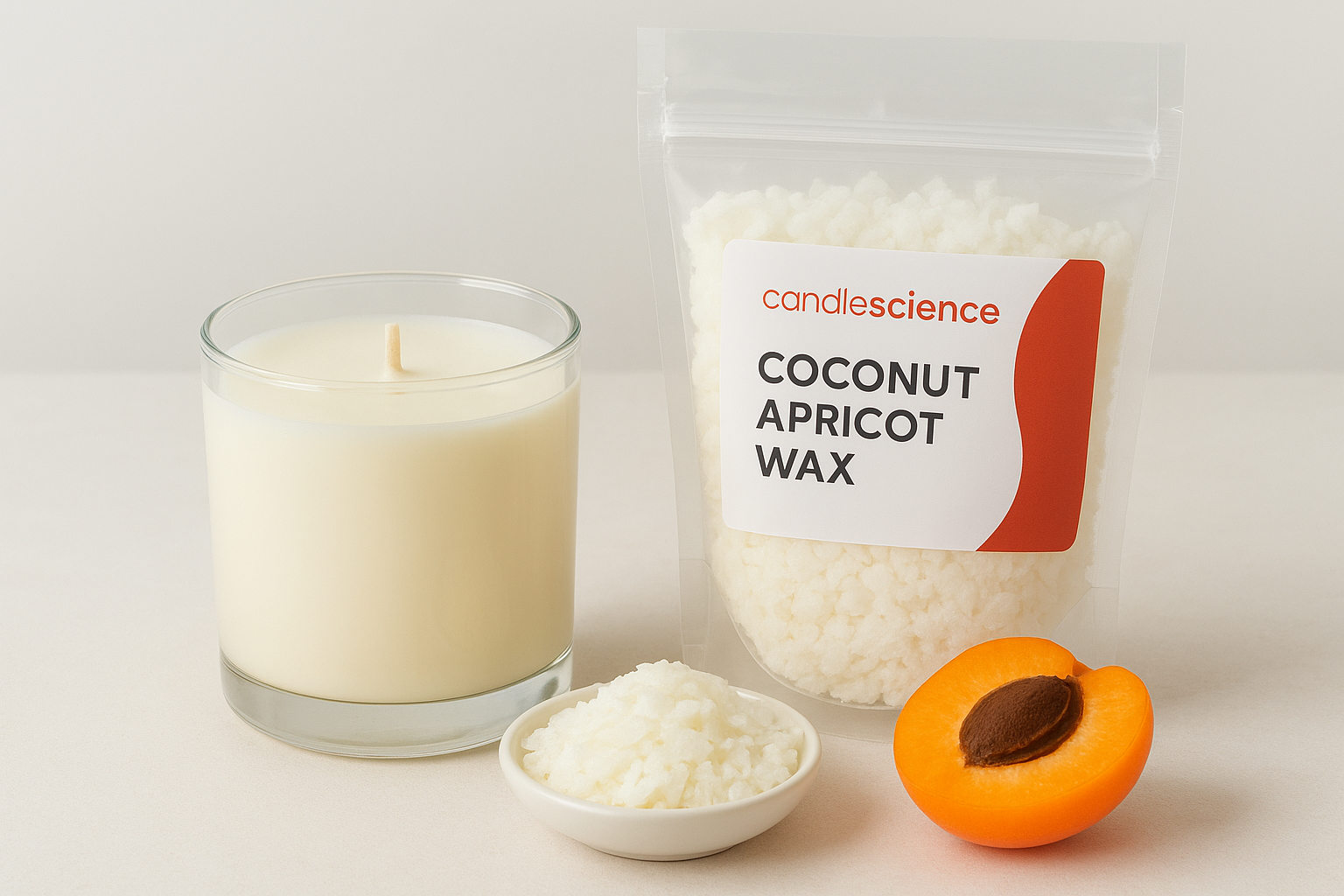
CandleScience Coconut Apricot Wax has become one of the most discussed options among small-batch makers, and it regularly shows up near the top of any honest candlescience wax guide. It's a natural blend that performs consistently across container sizes without demanding constant recipe adjustments.
What it is and why makers like it
This wax is a blend of coconut and apricot oils, which gives it a creamy texture that pours cleanly and sets with a smooth, slightly glossy finish. Makers appreciate it because it accepts fragrance loads up to 10% without significant bleed. It's softer than soy, which means it clings to fragrance molecules effectively and delivers a consistent scent experience from the first burn to the last.
Key reasons makers choose this wax:
- Natural ingredient list appeals to buyers who read labels
- High fragrance acceptance reduces the need for multiple test batches
- Glossy finish looks polished in retail packaging without any additives
Best projects for this wax
Coconut Apricot Wax is built for container candles, especially those poured into glass jars where the visible surface matters. It performs best in straight-sided vessels because the wax adheres cleanly to the glass, reducing wet spots. If you're building a product line where presentation and scent both need to land, this wax handles both.
Scent throw and finish expectations
The hot throw on this wax is strong, particularly after a full 48 to 72-hour cure before the first burn. Cold throw is also notable, meaning an unlit candle will scent a room just sitting on a shelf, which matters a lot for retail or gift applications.
Give this wax at least 48 hours to cure before testing scent throw, because a shorter window will give you a misleading result every time.
Key specs to compare
| Spec | Detail |
|---|---|
| Melt point | 100-110°F |
| Fragrance load | Up to 10% |
| Recommended pour temp | 125-135°F |
| Application | Container candles only |
Common pitfalls and how to avoid them
The most common mistake with this wax is pouring too hot, which causes surface bubbling and uneven tops. Keep your pour temperature between 125 and 135°F and pour at a slow, steady rate.
Wick sizing also runs tricky with this blend. The softer consistency can cause mushrooming with oversized wicks, so test one size smaller than what you'd default to with soy. Document every test batch so you build a reliable reference instead of restarting from scratch each time.
2. Golden Brands 464 soy wax
Golden Brands 464 is one of the most widely used soy waxes available through CandleScience, and it earns its place in nearly every candlescience wax guide for good reason. It's a container soy wax that balances ease of use with reliable results, making it a solid starting point for beginners and a dependable workhorse for experienced makers.
What it is and how it behaves
464 is a 100% soy wax with a naturally soft consistency that creates excellent glass adhesion. It has a low melt point around 115-120°F, which means it pours at cooler temperatures and sets with a smooth top surface in most conditions.
Best projects for this wax
This wax is designed exclusively for container candles. It performs especially well in straight-sided glass jars where adhesion and surface appearance are priorities for your finished product.
Scent throw and finish expectations
464 delivers solid hot throw with fragrance loads up to 10%, though most makers find the sweet spot around 6-8%. Cold throw is mild compared to coconut-based blends, so adjust your expectations before building a retail product around unlit scent performance.
Cure 464 candles for a full 48 to 72 hours before testing scent throw to get an accurate read on performance.
Key specs to compare
| Spec | Detail |
|---|---|
| Melt point | 115-120°F |
| Fragrance load | Up to 10% |
| Recommended pour temp | 125-135°F |
| Application | Container candles only |
Common pitfalls and how to avoid them
464 is prone to frosting and sinkholes if you pour too hot or rush the cooling process. Keep your pour temperature between 125 and 135°F and let candles cool at room temperature, away from drafts, to get consistent results batch after batch.
3. Golden Brands 444 soy wax
Golden Brands 444 sits in the same soy wax family as 464 but with a higher melt point that changes how it handles across different applications. Any solid candlescience wax guide covers both, because the differences matter once you move beyond basic container work.
What changes versus 464
The key difference is firmness. 444 has a melt point of 125-130°F, making it noticeably harder at room temperature than 464. This added structure reduces surface sweating at higher fragrance loads and improves shape retention in warmer storage environments.
- Firmer at room temperature than 464
- Less prone to bleed at fragrance loads above 8%
- Holds its shape better before and after packaging
Best projects for this wax
444 performs well in container candles and tart melts, giving you more range than 464 alone. It holds up in clamshell molds where the softer 464 formula loses shape before packaging.
Scent throw and finish expectations
Hot throw is solid with fragrance loads up to 9%, though 444 tends to deliver a slightly drier scent profile than softer coconut-based blends. Cold throw is mild, consistent with most pure soy options, so manage expectations for retail shelf scent performance.
Cure 444 candles for at least 48 hours before testing scent throw, particularly for tart melt applications.
Key specs to compare
| Spec | Detail |
|---|---|
| Melt point | 125-130°F |
| Fragrance load | Up to 9% |
| Recommended pour temp | 130-145°F |
| Application | Containers and tart melts |
Common pitfalls and how to avoid them
Pouring below 130°F causes poor glass adhesion and uneven tops in container applications. Keep your pour temperature within the recommended 130-145°F range and let candles cool slowly at room temperature, away from drafts, for the cleanest and most consistent finish across your batches.
4. IGI 6006 paraffin soy blend wax
IGI 6006 is the paraffin soy blend in this candlescience wax guide, and it brings a different performance profile than any pure soy or coconut option on this list. If scent throw is your top priority, this wax deserves serious attention.
What it is and why blends work
6006 combines paraffin and soy in a ratio designed to capture strengths from both. The paraffin side adds firmness and superior fragrance throw, while the soy component softens the formula enough for practical container use.
Best projects for this wax
This wax works best in container candles, particularly where strong scent performance matters more than an all-natural ingredient list. It suits makers who want a reliable, high-output formula for everyday products.
Scent throw and finish expectations
IGI 6006 delivers the strongest hot throw of any wax in this comparison. The paraffin base carries fragrance more aggressively, and you'll notice the difference within the first 20 minutes of a burn.
If scent performance is your primary goal, 6006 will consistently outperform every pure soy option in this list.
Key specs to compare
| Spec | Detail |
|---|---|
| Melt point | 160-165°F |
| Fragrance load | Up to 12% |
| Recommended pour temp | 160-180°F |
| Application | Container candles |
Common pitfalls and how to avoid them
The most common mistake is pouring too cool, which causes poor glass adhesion and a rough finished surface. Keep your pour temperature within the recommended 160-180°F range and allow candles to cool slowly for consistent results across batches.
5. CandleScience CocoSol Soy Pillar Wax
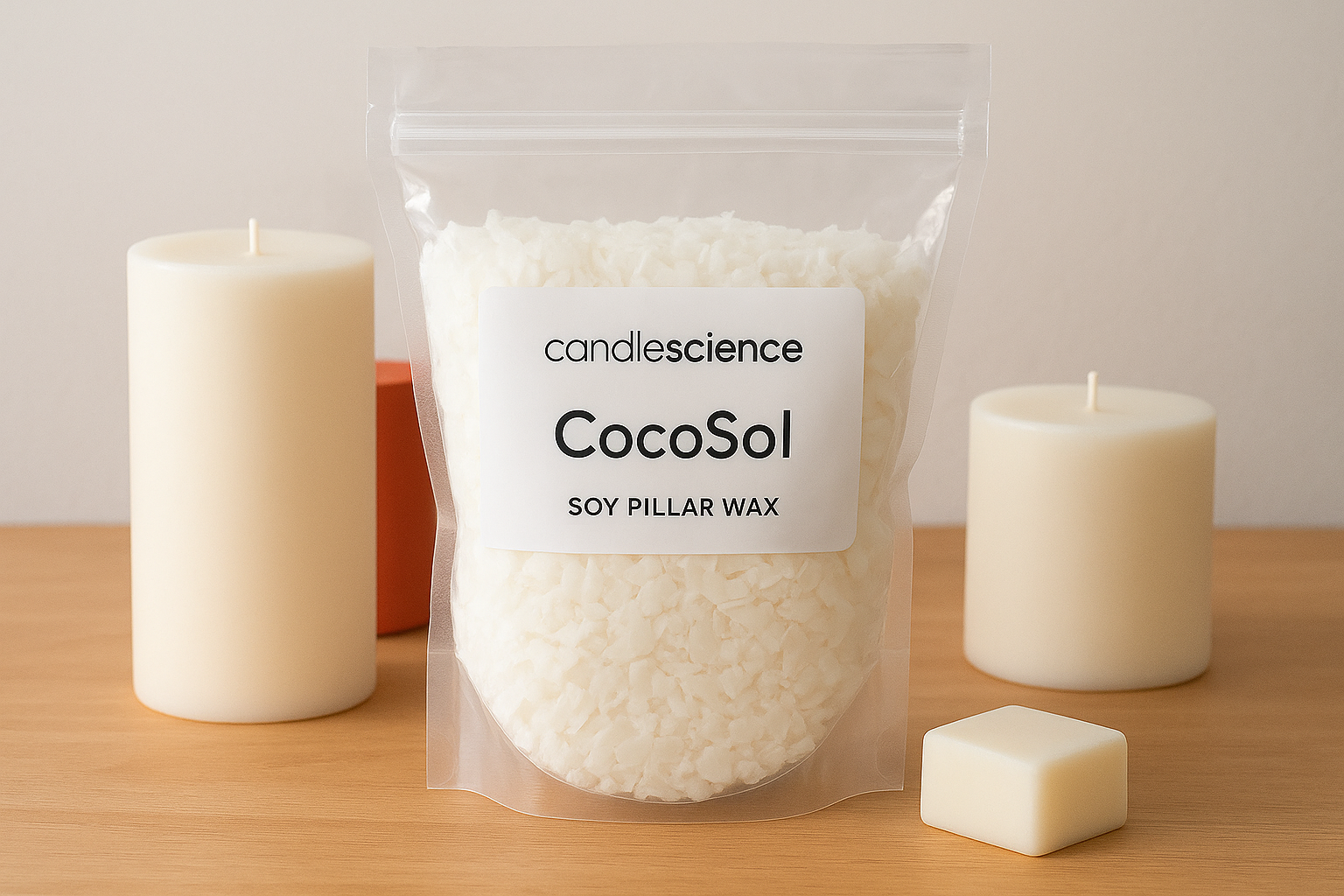
CocoSol rounds out this candlescience wax guide as the only option built specifically for freestanding candle forms. It fills a gap that no other wax on this list addresses.
What it is and what makes it different
This coconut and soy blend is formulated with a higher melt point that gives it the rigidity freestanding candles need to hold their shape without a container. Unlike every container wax in this comparison, CocoSol unmolds cleanly while still carrying the natural, plant-based appeal that buyers increasingly look for on ingredient labels.
Best projects for this wax
CocoSol is designed for pillar candles, wax melts, and molded shapes. If you want to expand your product line beyond containers, CocoSol gives you a reliable base for structured forms that hold up before and after packaging.
Scent throw and finish expectations
You can expect moderate hot throw from CocoSol, with fragrance loads capped around 6%. The surface finish is smooth and matte, which suits pillars and molded shapes where a natural, understated look is the point.
Test CocoSol in your specific mold before committing to a full batch, because release performance varies depending on mold material.
Key specs to compare
| Spec | Detail |
|---|---|
| Melt point | 130-140°F |
| Fragrance load | Up to 6% |
| Recommended pour temp | 150-160°F |
| Application | Pillars, melts, and molded candles |
Common pitfalls and how to avoid them
The most common mistake with CocoSol is overloading fragrance, which causes the wax to sweat and lose structural integrity after unmolding. Keep your fragrance load at or below 6% and allow a full cure before handling to protect the finished shape across every batch.
Quick Recap and Next Steps
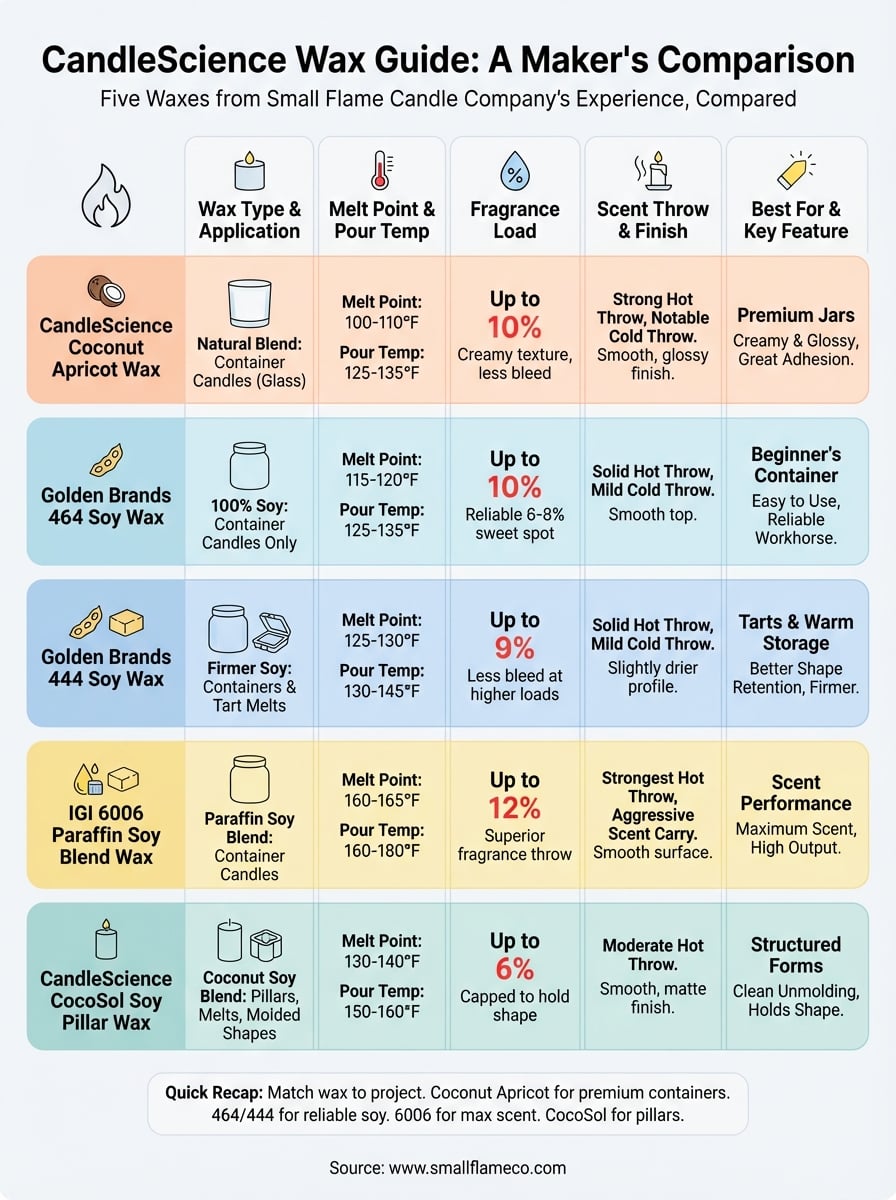
This candlescience wax guide covered five waxes with distinct strengths. Coconut Apricot Wax leads for container candles where presentation and scent both matter. Golden Brands 464 is the reliable beginner-friendly soy option for straightforward container work, while 444 adds firmness for tart melts and warmer storage environments. IGI 6006 wins on raw scent performance if a natural ingredient list isn't a requirement. CocoSol fills the gap for pillars and molded forms that need to hold their shape without a container.
Your best starting point is matching the wax to your specific project type before testing anything else. If you want to see what hand-poured candles look like when the wax choice gets made thoughtfully from the start, browse the full collection at Small Flame Candle Company. Every scent we pour reflects the same wax selection process this guide walked you through.