

How To Package Candles For Shipping Without Damage & Melting
We've shipped thousands of hand-poured candles at Small Flame Candle Company, and we've learned the hard way that a beautiful candle means nothing if it arrives cracked, melted, or rattling around in a box. Figuring out how to package candles for shipping the right way took us real trial and error, and we want to save you that headache. Whether you're running a candle business or sending a gift across the country, proper packaging is the difference between a five-star experience and a refund request.
Candles are awkward to ship. They're fragile, heat-sensitive, and heavier than people expect. A jar candle that survives your kitchen counter just fine can shatter from a three-foot drop off a conveyor belt. Wax can soften or warp if a package sits in a hot truck for hours. These aren't rare scenarios, they're everyday realities of parcel shipping.
This guide walks you through everything we use and recommend: the right box sizes, cushioning materials, heat protection strategies, and carrier tips that actually work. Every suggestion here comes from hands-on experience packing and shipping our own candles from our workshop. By the end, you'll have a clear, repeatable process for getting candles from point A to point B in perfect condition.
What you need before you pack a candle order
Gathering your supplies before you start packing saves time and prevents the frustration of half-done packages sitting open while you hunt for tape. Learning how to package candles for shipping the right way starts with having the correct materials on hand before you touch a single candle. Running out of bubble wrap mid-pack or grabbing a box that's two inches too wide costs you time, money, and potentially a broken candle at the destination.
Boxes, cushioning, and wrapping materials
Your box choice matters more than most people realize. A corrugated cardboard box with at least 200 lb. burst strength is the minimum standard for candles, and you want 2 to 3 inches of clearance on every side of the candle so cushioning can absorb impact. Double-walled boxes are worth the extra cost for anything over 8 oz. or for orders shipping cross-country.
Choose a box that fits snugly around your cushioning layer, not around the candle itself. Tight cushioning absorbs the shock; a tight box does nothing to protect the product.
Here's a full materials list to have ready before you start packing:
- Corrugated cardboard boxes sized to your candle with room for padding on all sides
- Bubble wrap (small-cell for single candles, large-cell for jars and pillars)
- Kraft paper or packing paper for void fill
- Foam sheets or foam corner inserts for added protection on glass jars
- Tissue paper for the first wrap layer to protect labels and finishes
- Packing tape rated for shipping, at least 2-inch width
- Fragile stickers or a permanent marker for package labeling
Heat protection and sealing supplies
Shipping candles in warm months adds one more layer of planning to your process. Stock insulated box liners made from foam or foil-backed material to slow heat transfer inside the package, and pair them with gel packs or cold packs if you're shipping during summer or to warm-climate destinations.
Keep a roll of heat-warning labels on hand too. Carriers won't keep your package cool, but a visible label at least signals handlers to avoid leaving it on a hot loading dock. Store these heat protection items alongside your standard packing supplies so you're never caught short during a heat wave.
Step 1. Prep each candle so it can't scuff or crack
Before you place any candle into a box, spend 60 seconds prepping it individually. Bare candles shift and rub against packing materials, which scratches labels, chips wax edges, and leaves glass jars with surface cracks that customers notice immediately. This step is often skipped, but it's one of the most important parts of learning how to package candles for shipping the right way.
Wrap each candle before it touches anything else
Start with a single layer of tissue paper around the candle body to protect the label and wax finish. Then wrap the entire candle in two full layers of small-cell bubble wrap, securing each layer with a small piece of tape so it doesn't unravel inside the box. Make sure the bubble wrap extends past the top and bottom of the candle by at least one inch on each end.
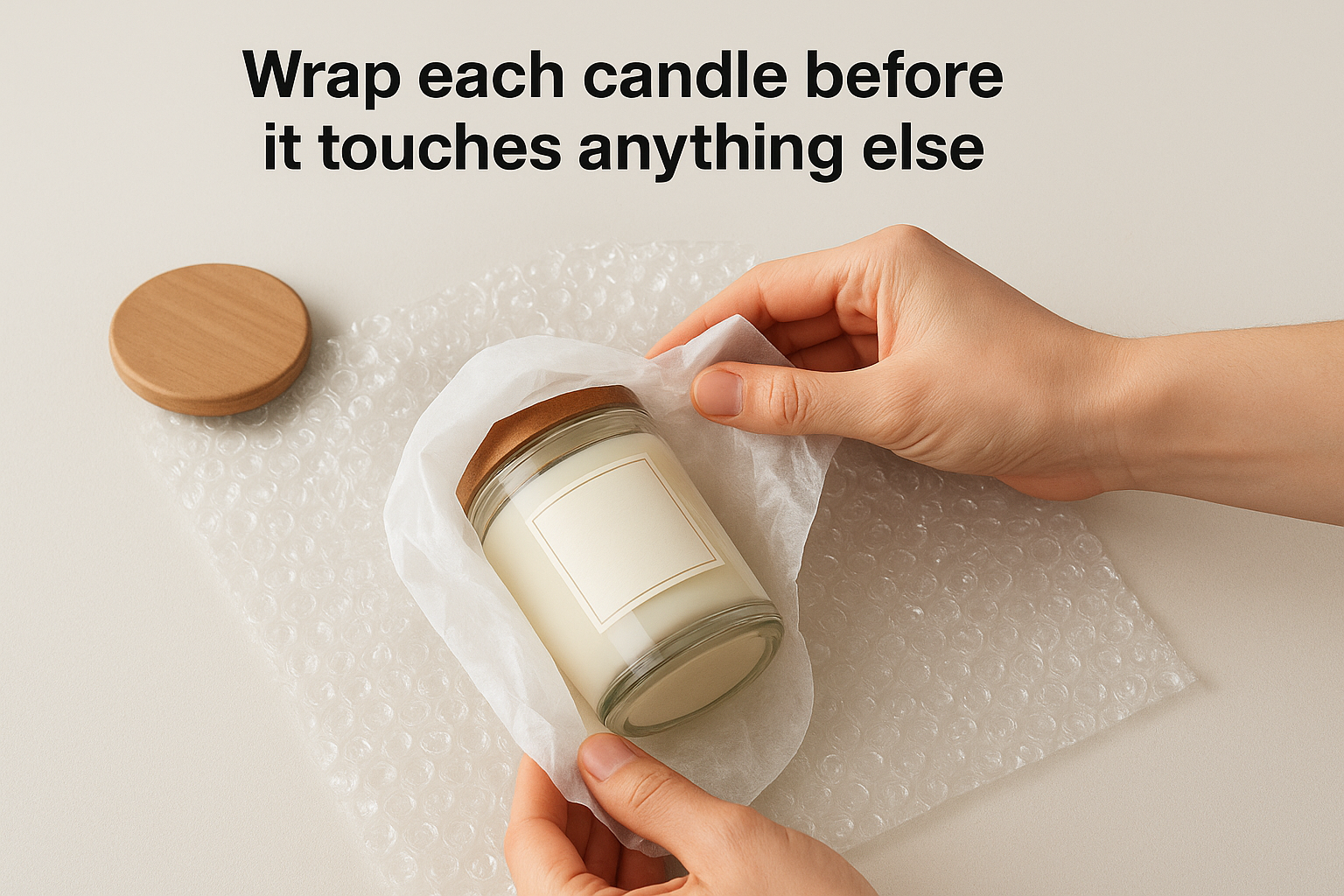
Never skip the tissue paper layer under bubble wrap - the plastic bubbles can press directly into a paper label and leave permanent indentations.
Follow this wrap sequence every time:
- Lay the candle on tissue paper and roll it snugly
- Tape the tissue paper closed
- Center the wrapped candle on a sheet of bubble wrap
- Roll and fold the ends in like wrapping a gift
- Tape all open edges closed
Secure lids and protect wax surfaces
If your candle has a lid or dust cover, tape it closed with a small strip of tape before wrapping so it doesn't pop open mid-shipment. For pillar candles or exposed wax surfaces, add a foam sheet directly against the wax before the bubble wrap layer to prevent the wax from picking up impressions during transit.
Step 2. Build a snug, no-movement cushion in the box
Once your candles are individually wrapped, your next job is making sure they cannot move at all inside the box. Movement is what causes damage. A candle that shifts even a half-inch during a drop or a hard corner turn generates enough force to crack glass or chip wax, no matter how carefully you wrapped the individual piece. This step is where knowing how to package candles for shipping correctly goes from theory to practice.
Layer the bottom of the box first
Start by placing at least 2 inches of cushioning material on the box floor before you set any candle inside. Crumpled kraft paper works for lighter candles, but foam sheets cut to match the box base give you more reliable compression protection because they hold their shape under force. Set your wrapped candle in the center of that base layer, away from every wall.
The cushion needs to compress on impact, not just fill empty space. Loosely packed paper crumples flat under a hard drop; foam holds its shape and absorbs the shock instead.
Follow this layering order every time you pack a single candle:
- 2-inch base layer of foam or tightly crumpled kraft paper
- Wrapped candle centered on the base layer
- Bubble wrap or packing paper packed firmly on all four sides
- Final 2-inch top layer of foam or crumpled paper
- Close the box flaps - they should press down with light resistance
Test for movement before you seal
Press down firmly on the closed flaps and shake the box in every direction. You should hear and feel nothing moving inside. If the candle shifts at all, open the box and add more fill material on the side where the gap exists, then test again.
Step 3. Seal, label, and test the package like a carrier would
Sealing and labeling is the last line of defense before your package enters a system designed for speed, not care. Carriers run packages through automated sorters, stack them in trucks, and drop them onto conveyor belts. A weak seal or missing label can turn a perfectly packed candle into a broken one before it leaves the first facility. This step is easy to rush, and that's exactly when mistakes happen.
Seal every seam with the right tape
Run two full strips of 2-inch packing tape along the center seam of the top and bottom flaps, then add one strip along each side seam where the flaps meet the box walls. Never use regular office tape or masking tape; they fail under temperature changes and rough handling. A reinforced tape like Scotch 3850 or similar shipping-grade tape holds the box closed even when the outside gets damp or scuffed in transit.
The H-taping method (one strip down the center seam and one across each end) is the carrier-approved minimum; add side seams on top of that for any box holding glass jars.
Label clearly so nothing gets mishandled
Place your shipping label flat on the largest box face, not across a seam or fold. Add a "Fragile" sticker directly below the label and one on the opposite side of the box. Once labeled, pick the box up and shake it one final time to confirm nothing shifts. Knowing how to package candles for shipping correctly means the box you hand to a carrier is sealed, labeled, and ready for anything the delivery network throws at it.
Step 4. Ship in hot weather without melt risks
Hot weather is the one variable you can't control once a package leaves your hands. Parcel trucks regularly hit 120 to 140 degrees Fahrenheit inside during summer months, and your candles don't need to fully melt to arrive damaged. Soft wax, warped surfaces, and labels that peel in the heat are all real outcomes when you skip heat protection, even for short regional shipments.
Know when heat becomes a real threat
Most soy and paraffin candles start softening between 80 and 100 degrees Fahrenheit, which means any summer shipment in the continental US is at risk. The danger isn't just peak heat days; packages sitting on loading docks or in unventilated delivery vehicles can reach damaging temperatures even on a 75-degree afternoon.
If the forecast shows temperatures above 75°F along your shipping route, treat it as a hot-weather shipment and add insulation every time.
Use this quick guide to match protection level to conditions:
| Forecast Temperature | Recommended Protection |
|---|---|
| Below 75°F | Standard packaging only |
| 75 to 85°F | Insulated box liner |
| 85 to 95°F | Liner plus gel pack |
| Above 95°F | Expedite shipping + liner + two gel packs |
Use insulation and cold packs correctly
Place your foil-backed insulated liner inside the box before any cushioning goes in. It lines all four walls and the top and bottom, creating a barrier that slows heat transfer significantly. Wrap gel packs in a single layer of kraft paper before placing them in the box so condensation doesn't soak your packaging materials during transit.
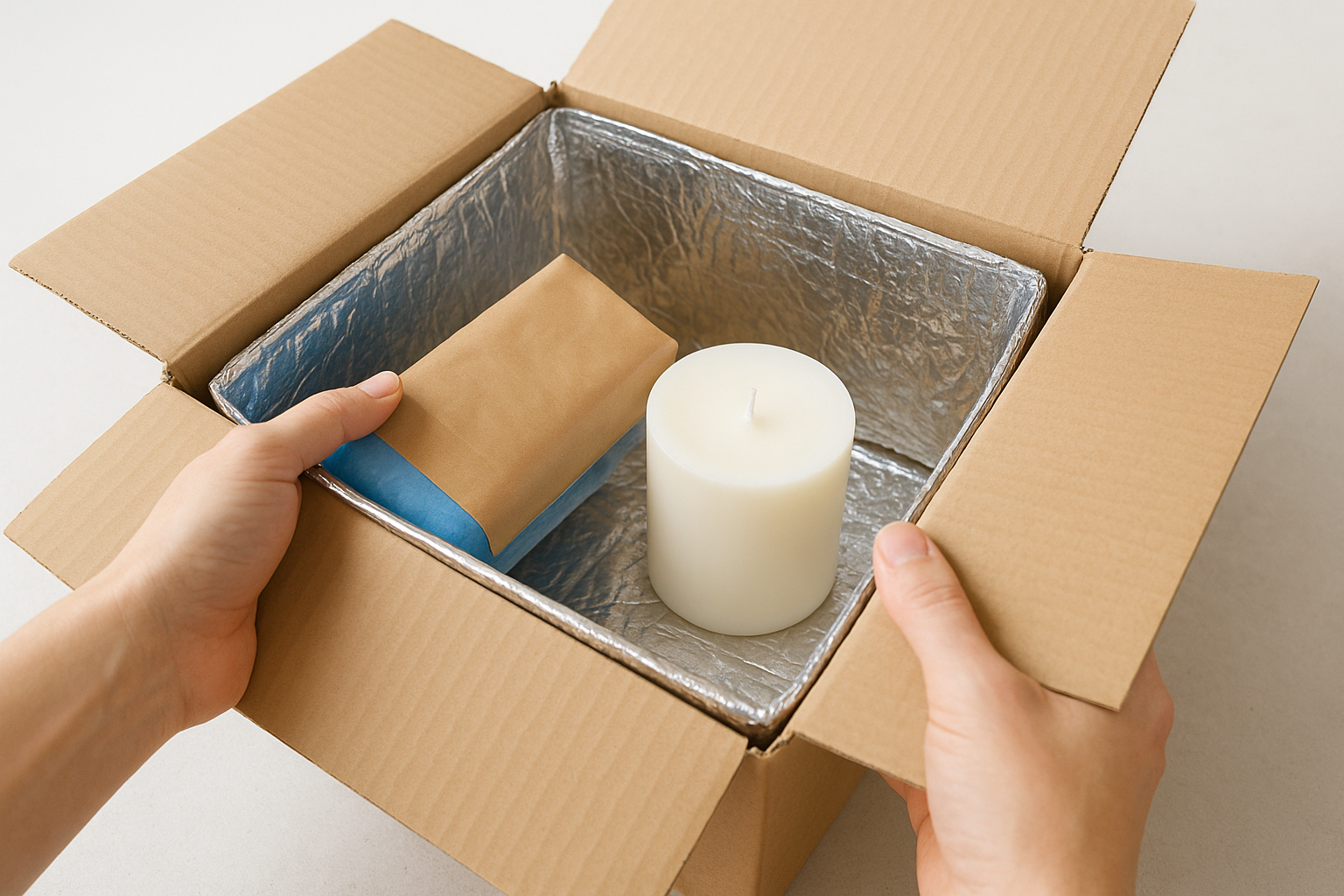
Knowing how to package candles for shipping in summer also means timing your ship days correctly. Avoid handing packages to carriers on Fridays if ground delivery takes more than two days, since your package will sit in a hot facility over the weekend.
Step 5. Choose shipping options and price shipping correctly
Carrier selection and shipping rates affect every order you send, and getting both wrong turns profit into a loss before the candle even leaves your hands. Understanding how to package candles for shipping is only half the job; knowing which carrier to use and what to charge your customers locks in the economics of every shipment.
Pick the right carrier for candle shipments
Your three main options are USPS, UPS, and FedEx, and each one handles candle shipments differently. USPS Priority Mail works well for small, lightweight candles under 2 lbs. because flat-rate options keep costs predictable regardless of destination. UPS and FedEx become more cost-effective for heavier multi-candle orders or for shipments requiring guaranteed delivery windows, since both offer better dimensional weight pricing on larger boxes at commercial rates.
If you ship more than 20 packages per month, open a business account with UPS or FedEx directly since negotiated rates can cut your per-package cost by 15 to 30 percent compared to retail counter pricing.
Price shipping so you don't lose money
Many small candle sellers charge a flat shipping rate and lose money on anything that ships farther than two zones away. The smarter approach is to calculate your average package weight including all packaging materials, then run that number through each carrier's rate calculator before setting your store's shipping prices. Add a handling fee of $0.50 to $1.00 per order on top of the carrier rate to cover the cost of boxes, bubble wrap, tape, and the time it takes to pack correctly. That small addition keeps your materials costs covered without making your prices look unreasonable to buyers.
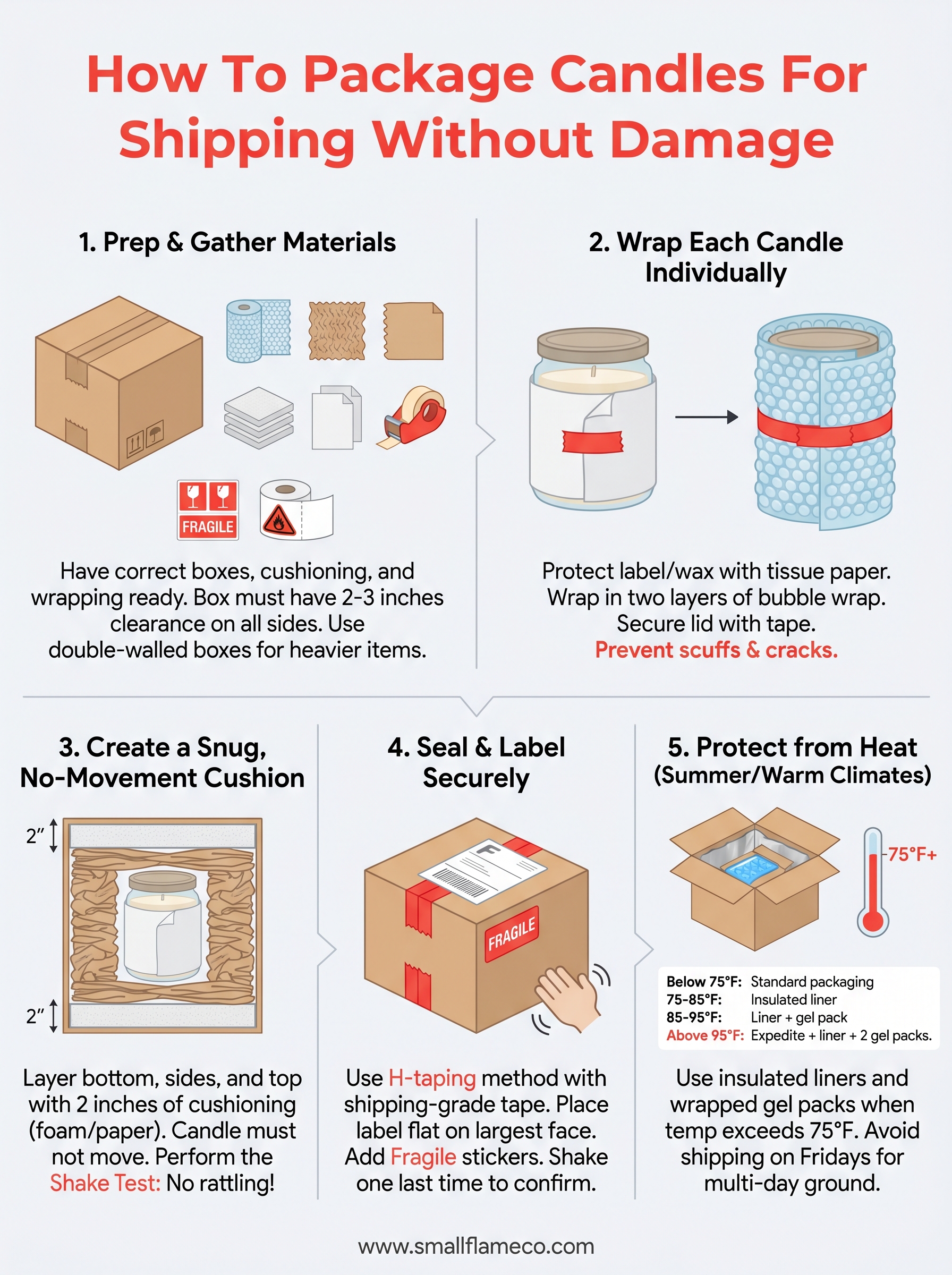
Final checklist before you ship
Run through this list on every order before it leaves your hands. Knowing how to package candles for shipping the right way only pays off if you execute each step consistently, not just when you remember to.
- Each candle wrapped in tissue paper, then two layers of bubble wrap
- Lid or dust cover taped closed
- 2-inch cushion layer on the box bottom, all sides, and top
- Box passes the shake test with zero movement inside
- All seams sealed with shipping-grade packing tape
- Fragile stickers applied to at least two sides
- Shipping label placed flat on the largest box face
- Insulated liner and gel pack included if forecast exceeds 75°F
- Ship day avoids Friday for multi-day ground delivery
Pack carefully and your customers receive exactly what they ordered. If you want candles worth shipping, browse our hand-poured coconut wax candles built to impress from the first burn.