

How To Store Candles Long Term: Keep Scent & Shape Safely
You picked out the perfect scent, waited for the candle to arrive, and now it sits in a closet because the timing isn't right. Maybe you stocked up during a sale, or you're saving a seasonal favorite for later. Either way, knowing how to store candles long term matters more than most people realize. Without the right conditions, wax warps, wicks degrade, and that fragrance you fell in love with fades to almost nothing.
At Small Flame Candle Company, we hand-pour every candle we sell. That process gives us a front-row seat to how wax, fragrance oils, and wicks respond to heat, light, and time. We've watched beautifully crafted candles lose their throw after sitting in a hot garage for a few months, and we've seen others stay perfect for well over a year because they were stored correctly. The difference comes down to a few simple choices.
This guide covers everything you need to protect your candles during extended storage, from ideal temperatures and lighting conditions to the best containers and positioning. Follow these steps, and your candles will burn just as well the day you finally light them as the day they were poured.
What long-term storage does to candles
Candles are more fragile than they look. Wax, fragrance oils, and wicks each react differently to environmental stress, and when you store candles long term without thinking about conditions, those reactions compound against each other. A candle sitting in the wrong spot for even three months can arrive at its burn date looking, smelling, and performing like a completely different product from the one you originally bought.
Heat and physical deformation
Heat is the most immediate threat to any candle. Wax softens at surprisingly low temperatures. Soy wax, which Small Flame uses for its hand-poured candles, can begin losing its shape at temperatures as low as 75°F to 80°F, especially under sustained exposure. A car trunk in summer, a garage shelf near the water heater, or a sunny windowsill can push well past that threshold within minutes.
When wax warps, it's not just a cosmetic problem. A deformed candle creates an uneven melt pool once you finally light it, which leads to tunneling, poor hot throw, and wasted product. Pillar candles are especially vulnerable because they have no container walls holding their shape if the wax softens, but even jarred candles can sink, crack, or pull away from the glass under sustained heat.
Light and UV exposure
Sunlight and even strong artificial light attack candles from two directions at once. UV rays break down fragrance compounds suspended in the wax, reducing the scent throw you get when the candle burns. At the same time, prolonged light exposure fades dyes and pigments, so a richly colored candle turns pale and washed-out before you ever strike a match.
Even indirect sunlight filtering through a window can fade a candle's color and weaken its scent within a few weeks.
Wick and scent degradation
Wicks absorb moisture from the air over time. A damp or humidity-damaged wick will struggle to stay lit, produce more soot, and refuse to draw enough wax to maintain a steady flame. Fragrance oils face a parallel problem: they slowly migrate toward the surface of the wax or evaporate through the container walls, leaving you with a candle that smells faint cold and performs poorly once it burns. Knowing exactly what storage conditions trigger these problems puts you in a position to prevent all of them.
Choose the right space and conditions
When you know how to store candles long term, your first decision is picking the right location. The ideal storage space stays cool, dark, and dry year-round. Think interior closets, bedroom shelves, or a basement that doesn't experience humidity spikes. Rooms that share walls with the outside, like garages or sunrooms, tend to fluctuate too much in temperature to be reliable options, and that variability alone will degrade your candles faster than almost any other factor.
Temperature and airflow
Keep your storage area between 50°F and 70°F consistently. Fluctuations are just as damaging as sustained heat because repeated expansion and contraction causes wax to crack and pull away from the container. Avoid placing candles near heating vents, radiators, or any appliance that generates warmth. Good airflow matters too, but aim for gentle air circulation rather than a direct fan, which accelerates fragrance evaporation and dries out the wax surface faster than normal.
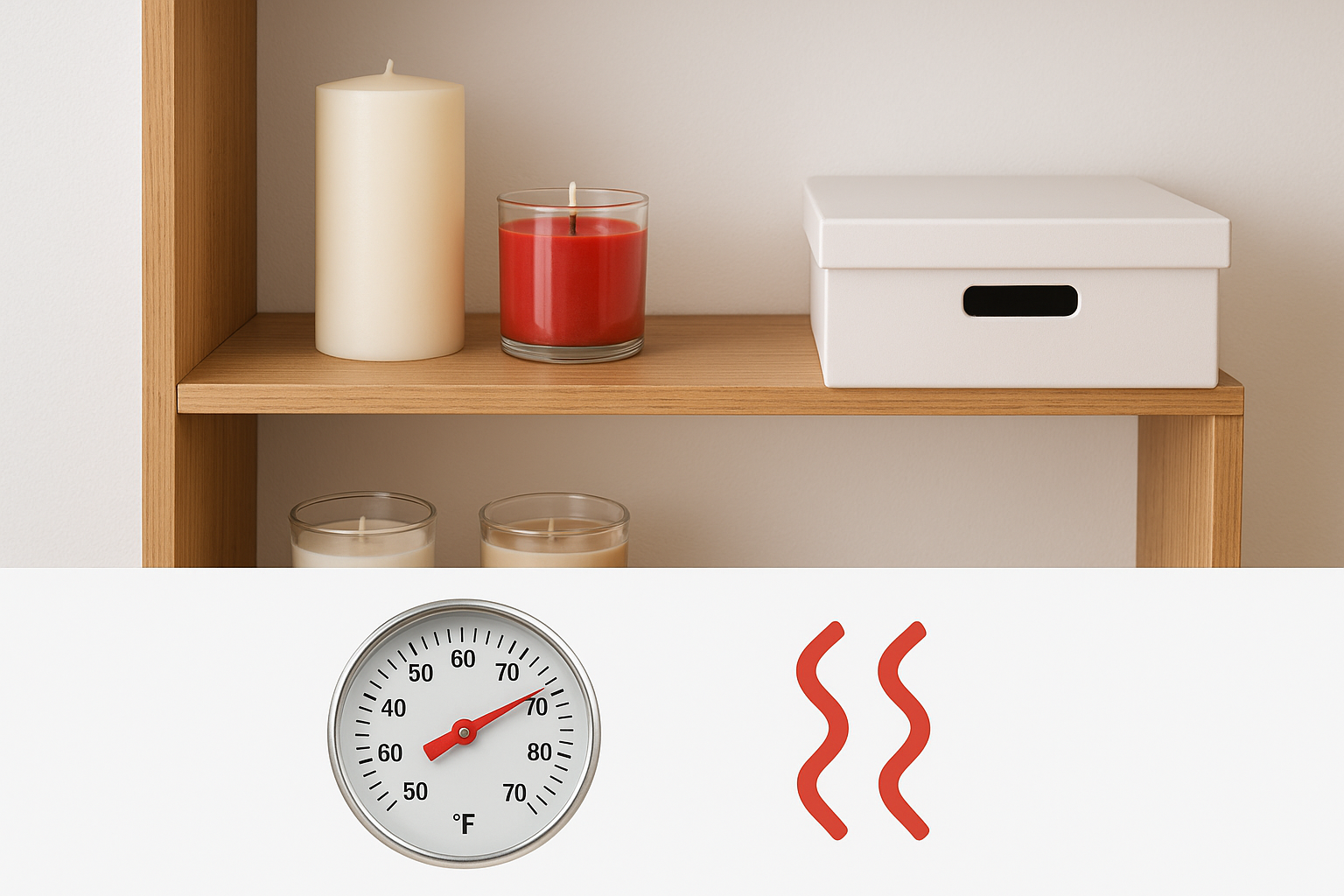
An interior closet on the north-facing side of your home is one of the most reliable long-term storage spots you can choose.
Light control and humidity levels
UV exposure fades both color and scent, so keep candles away from windows, skylights, and fluorescent overhead lights if you store them on open shelving. A closed cabinet or opaque storage box blocks light effectively without any added cost. Aim for 40% to 55% relative humidity in your storage area. High moisture degrades wicks and can promote mold on natural wax surfaces, while very dry air speeds up fragrance evaporation. A basic hygrometer lets you monitor conditions without guessing.
Pack and protect each candle type
Different candle formats need different packing strategies. A jarred candle has built-in protection from its container, but a pillar or taper sits exposed on all sides. Matching your packing method to the candle format is one of the most practical things you can do when figuring out how to store candles long term.
Container and jarred candles
Jarred candles are the easiest to store. Place the lid back on before storing, or cover the opening with plastic wrap secured with a rubber band if the lid is missing. This blocks dust, slows fragrance evaporation, and keeps the wick clean. Store jars upright on a flat surface and never stack them directly on top of each other, since the weight can crack the glass or press into the wax.
Pillar and taper candles
Pillar and taper candles need more active protection because exposed wax picks up dust and dents easily. Wrap each one in tissue paper or unbleached parchment, then place it in a rigid box or a cardboard tube. Store pillars flat or standing upright in padded containers to prevent bowing. Avoid plastic wrap directly on the wax surface, since some plastics react with fragrance oils and leave a film.
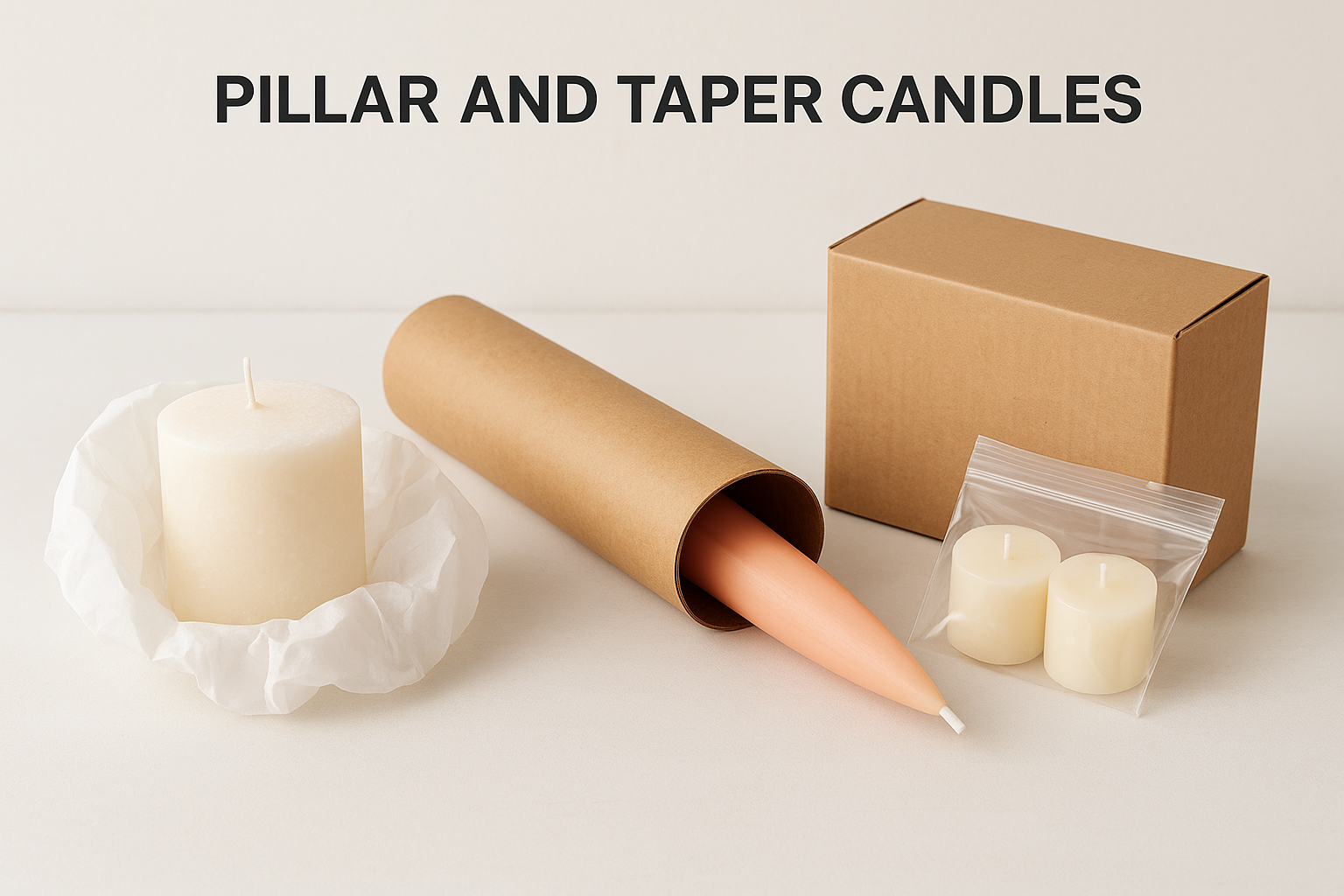
For tapers, a long cardboard tube from paper towels or gift wrap makes an excellent free storage sleeve.
Votives and tealights
Votives and tealights are small but still vulnerable to surface dust and scent transfer from nearby products. Keep them in a resealable container or zip-top bag, separated by type or scent. Never mix strongly scented candles in the same container without individual wrapping, or the fragrances will bleed into each other over time.
Prevent scent loss, dust, and color changes
When you focus on how to store candles long term, scent preservation, dust control, and color stability each need deliberate attention. Every issue has a specific cause and a direct fix. Handling all three together keeps your candles in the same condition they were in when you first bought them.
Slow down scent evaporation
Fragrance oils leave the wax gradually through off-gassing, and the rate increases in warm or ventilated spaces. Your best defense is sealing every candle before storage: lids on jars, parchment wrap on pillars, and everything in a sealed container afterward. Keep strong and light scents stored separately to prevent fragrance crossover, which changes the original scent profile of each candle over time.
Storing candles in individual zip-top bags is one of the simplest ways to lock in fragrance and slow off-gassing during long-term storage.
Here are the most effective steps to limit scent loss:
- Seal jar candles with their original lid before placing them in storage
- Wrap pillar and taper candles in unbleached parchment before boxing them
- Keep storage temperature at or below 70°F consistently
- Never store candles near air vents or open windows
Block dust and protect color
Dust embeds itself into exposed wax surfaces and dulls both the texture and appearance of a candle over time. Covering each candle with a lid, wrap, or sealed bag blocks dust before it settles. UV light drives most color fading, so keep your storage space dark or use opaque boxes on open shelves.
Use this quick reference to match the right protection to your candle format:
| Candle type | Dust protection | Color protection |
|---|---|---|
| Jarred candle | Replace lid or cover with plastic wrap | Store in opaque box or cabinet |
| Pillar candle | Wrap in parchment paper | Avoid all direct and indirect light |
| Votive or tealight | Seal in a zip-top bag | Keep in a fully closed container |
Fix common storage problems
Even with good intentions, storage conditions slip. When you know what to look for and how to respond, most candle storage issues are fixable before they ruin the product entirely. The table below maps the most common problems to their causes and direct solutions, giving you a clear starting point when something looks or smells off.
| Problem | Likely cause | Fix |
|---|---|---|
| Wax has warped or sunken | Heat exposure above 75°F | Move to a cooler location; reshape pillar by rolling gently on a flat surface |
| Color has faded | UV or light exposure | Wrap in opaque paper and store away from all light sources |
| Scent is barely detectable | Fragrance off-gassing over time | Seal in an airtight container immediately to slow further loss |
| Wick won't stay lit | Moisture absorption | Trim the wick to 1/4 inch and let it dry in a low-humidity space for 24 hours |
| White film on wax surface | Temperature fluctuation causing bloom | Buff gently with a soft cloth; this is cosmetic and does not affect performance |
Recover a warped pillar candle
Warped pillar candles are the most visually obvious problem you will encounter when learning how to store candles long term. If the wax bowed slightly during storage, place the candle on a flat, room-temperature surface and apply light, even hand pressure to roll it back into shape. For heavier deformation, rest the candle inside a snug cylindrical container overnight at around 65°F to coax the wax back toward its original form.
Restore a faded or weak scent
Fragrance loss is permanent once the oils have fully evaporated, but a candle that still smells faint cold can still perform well when it burns. Seal it in an airtight bag for 48 to 72 hours before burning to let any remaining fragrance redistribute through the wax before it reaches your wick.
A short "rest period" inside a sealed container before burning is the fastest way to recover noticeable cold throw from a candle that was stored improperly.
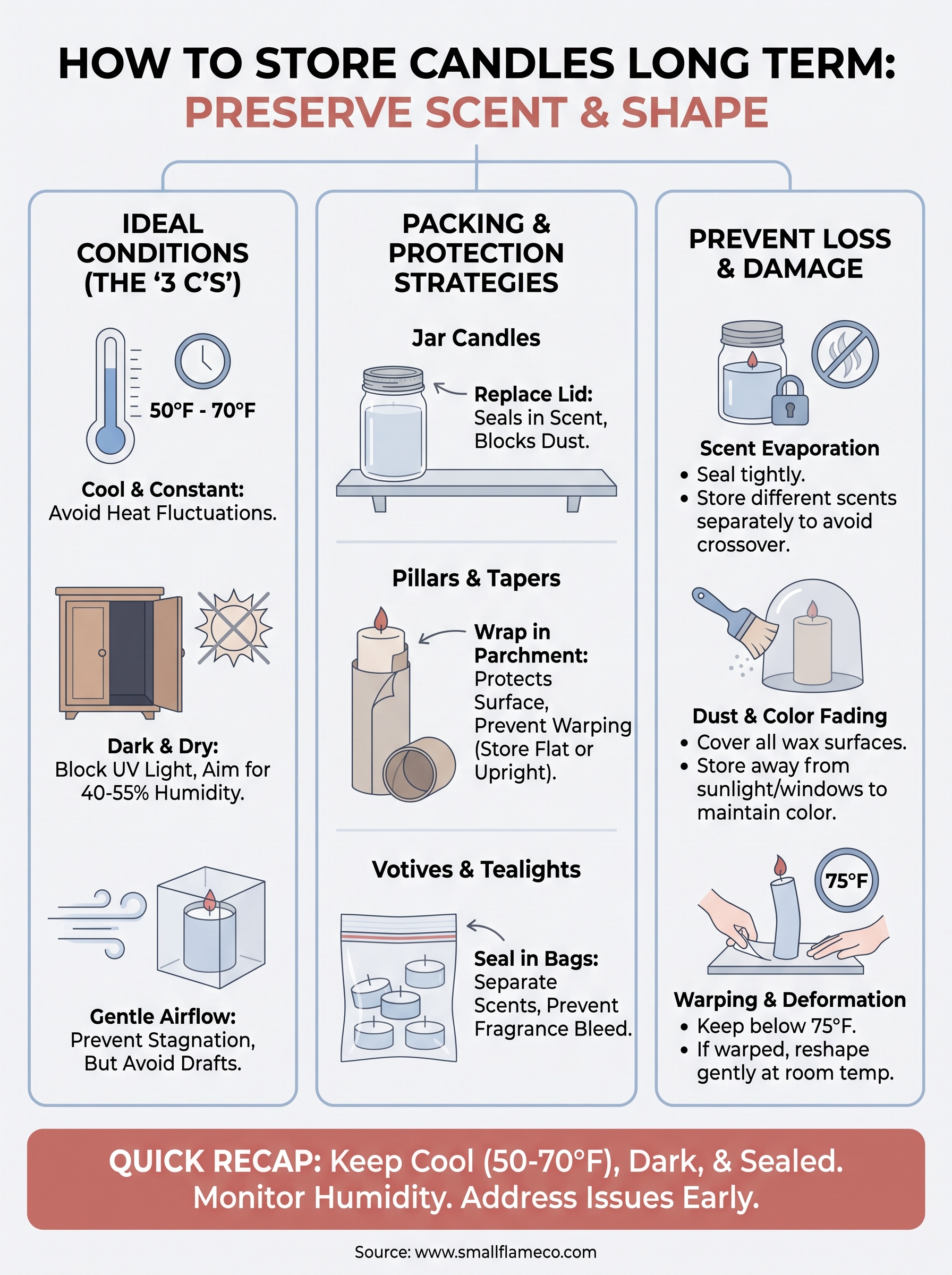
Quick recap
Knowing how to store candles long term comes down to controlling three variables: temperature, light, and airflow. Keep your candles between 50°F and 70°F in a dark, low-humidity space. Seal every candle before storage, whether that means replacing a jar lid, wrapping a pillar in parchment, or sliding votives into zip-top bags. Store different scents separately to prevent fragrance crossover, and always keep your candles away from windows, vents, and anything that generates heat.
If you notice a problem, address it early. Warped wax, faded color, and weak scent each have a direct fix, and catching them before the damage goes too far saves the candle. A well-stored candle burns exactly as intended, with a full scent throw and an even melt pool, from the first light to the last.
Ready to stock up on candles worth storing? Browse the hand-poured coconut wax candle collection at Small Flame Candle Co.