

How Much Fragrance Oil To Add To Soy Candles (6–10%)
Getting the fragrance load right can make or break a soy candle. Add too little oil and you're left with a weak scent throw that barely fills a room. Add too much and you risk sweating, poor wicks, or even safety issues. So the question stands: how much fragrance oil to add to soy candles? The short answer is 6–10% of the total wax weight, but the practical answer depends on your wax brand, fragrance type, and the size of candle you're pouring.
At Small Flame Candle Company, we hand-pour every candle we sell, which means we've tested fragrance loads across dozens of scent profiles, from bakery-inspired aromas to novelty favorites like Dr Pepper. That process taught us exactly where soy wax performs best and where it starts to push back. We've put that experience into this guide so you can skip the trial-and-error phase and start pouring candles that actually fill a room.
Below, you'll find the recommended fragrance oil percentages for soy wax, a simple formula to calculate your measurements by weight, and tips for adjusting your load based on scent type and container size. Whether you're pouring your first batch or troubleshooting weak throw on your fiftieth, this guide covers the numbers and the reasoning behind them.
What fragrance load means for soy candles
Fragrance load refers to the percentage of fragrance oil relative to the total weight of wax in your candle. When you ask how much fragrance oil to add to soy candles, you're really asking what fragrance load your wax can hold without causing problems. Most soy waxes handle 6–10% fragrance load, meaning for every 100 grams of wax, you add 6 to 10 grams of fragrance oil. Push past that ceiling and you'll see oil pooling on the candle's surface, wick clogging, or uneven burns.
Fragrance load is always calculated as a percentage of wax weight, not the weight of the finished candle or the jar it sits in.
Why soy wax has a lower fragrance load ceiling than paraffin
Soy wax is a plant-derived material with a different molecular structure than paraffin. Paraffin candles can often absorb up to 12% fragrance oil because their denser molecular makeup binds oil more effectively. Soy wax has a looser crystalline structure that can only retain so much fragrance before the oil separates out. That separation shows up as sweating, where small beads of fragrance oil appear on the candle's surface after it cools.
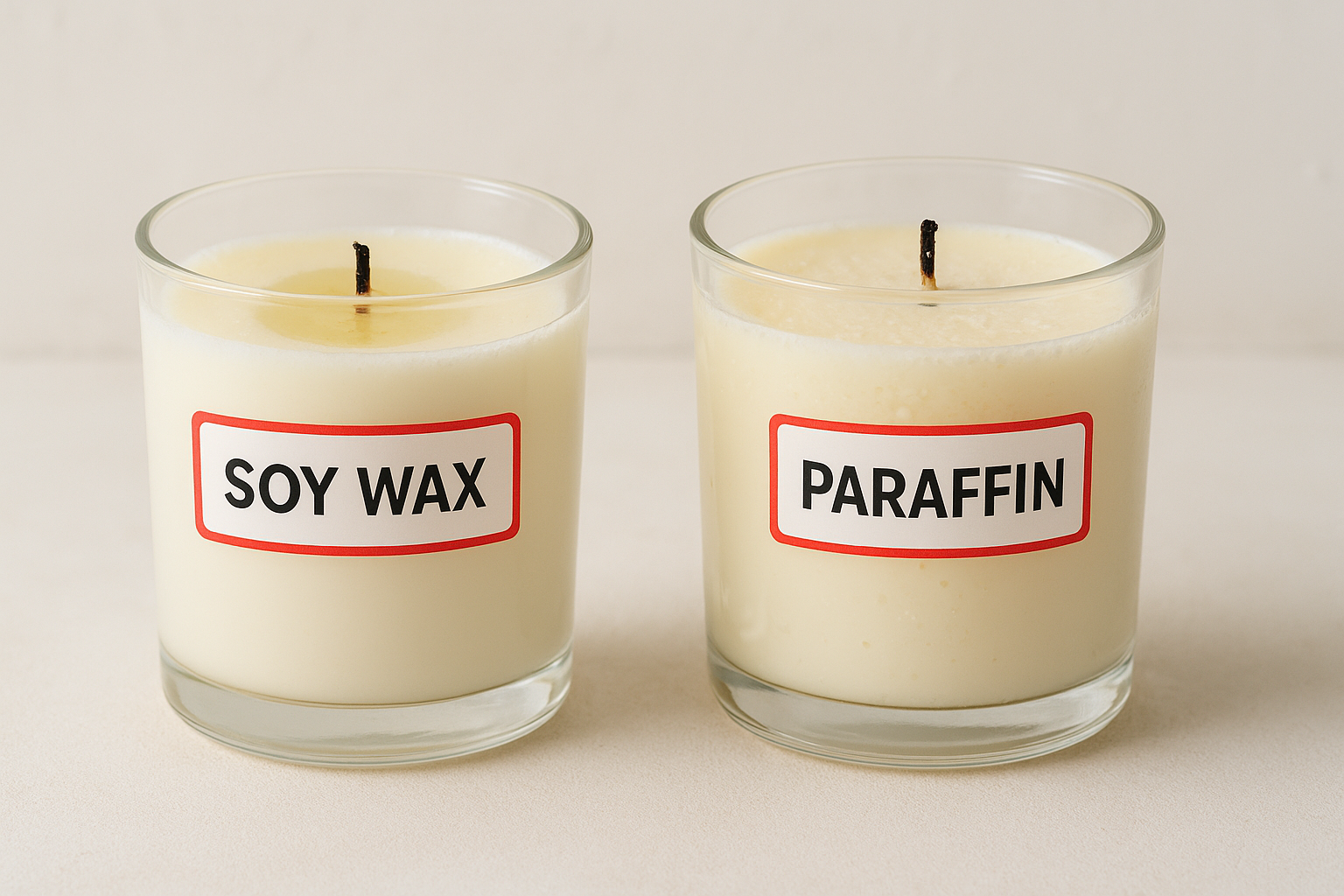
This is why most soy candle makers cap their fragrance load at 10% as a hard upper limit. Some soy blends, like Golden Brands 464, handle up to 10% cleanly, while others top out closer to 8%. Always check the manufacturer's recommended fragrance load for your specific wax before you pour a full batch, because the number varies by product, not just by wax type.
The difference between fragrance load and scent throw
Fragrance load is the amount of oil you add during production. Scent throw is how well the candle actually releases that fragrance, both while unlit (cold throw) and while burning (hot throw). These two things are related but not the same. You can add 10% fragrance oil and still end up with weak hot throw if your pour temperature was too low or your wick is undersized for the container diameter.
Soy wax typically delivers a stronger cold throw than paraffin, but it can underperform on hot throw if you skip key steps in the production process. A minimum cure time of 48 to 72 hours after pouring allows the fragrance molecules to fully bind with the wax, which directly improves both cold and hot throw. Skipping that cure window is one of the most common reasons new candle makers report weak scent even when their fragrance load looks correct on paper.
Step 1. Pick the right percentage for your goal
The right percentage depends on what you want the candle to do and which soy wax you're using. Not every candle needs a maxed-out fragrance load. A decorative candle on a shelf has different requirements than one you're pouring specifically to fill a large living room with scent. Start by identifying your goal before you calculate how much fragrance oil to add to soy candles.
Use 6-7% for lighter scents and smaller spaces
A 6-7% fragrance load is the right starting point for delicate or airy scents, such as clean linen, fresh cucumber, or subtle florals. These scent profiles often smell artificial or sharp at higher loads, so less oil actually produces a more pleasant result. It also works well for small-space candles like bathroom votives or bedroom jars under 8 oz, where a heavy scent throw would quickly overwhelm the room.
If your fragrance smells harsh or soapy at higher loads, drop back to 6% and retest before adjusting anything else.
Use 8-10% for strong hot throw or large containers
For bold scent profiles like bakery, spice, or novelty fragrances, an 8-10% load gives you the strength needed to compete with ambient odors in open-plan spaces. Larger containers, specifically jars 12 oz and above, also benefit from a higher load because more wax mass needs to carry the scent across a bigger melt pool.
Here's a quick reference to match your goal to a starting percentage:
| Goal | Recommended Load |
|---|---|
| Delicate or light fragrance | 6-7% |
| Standard home use | 8% |
| Strong throw, large jar | 9-10% |
Always treat these as starting points, not final answers. Your specific wax brand may perform slightly differently, so test one small batch at each percentage before committing to a full pour. If the scent still smells weak after a 48-hour cure, move up by 1% and retest.
Step 2. Use the formula and weigh everything
Once you've picked your target percentage, the math is simple. You calculate fragrance oil by weight in grams, not by volume, which means a digital kitchen scale accurate to at least one gram is the most important tool on your workbench. Measuring by volume with cups or spoons introduces error because fragrance oils vary in density from one scent to the next. Get the weight right and everything else follows directly from one formula.
The fragrance oil formula
The formula for figuring out how much fragrance oil to add to soy candles is:
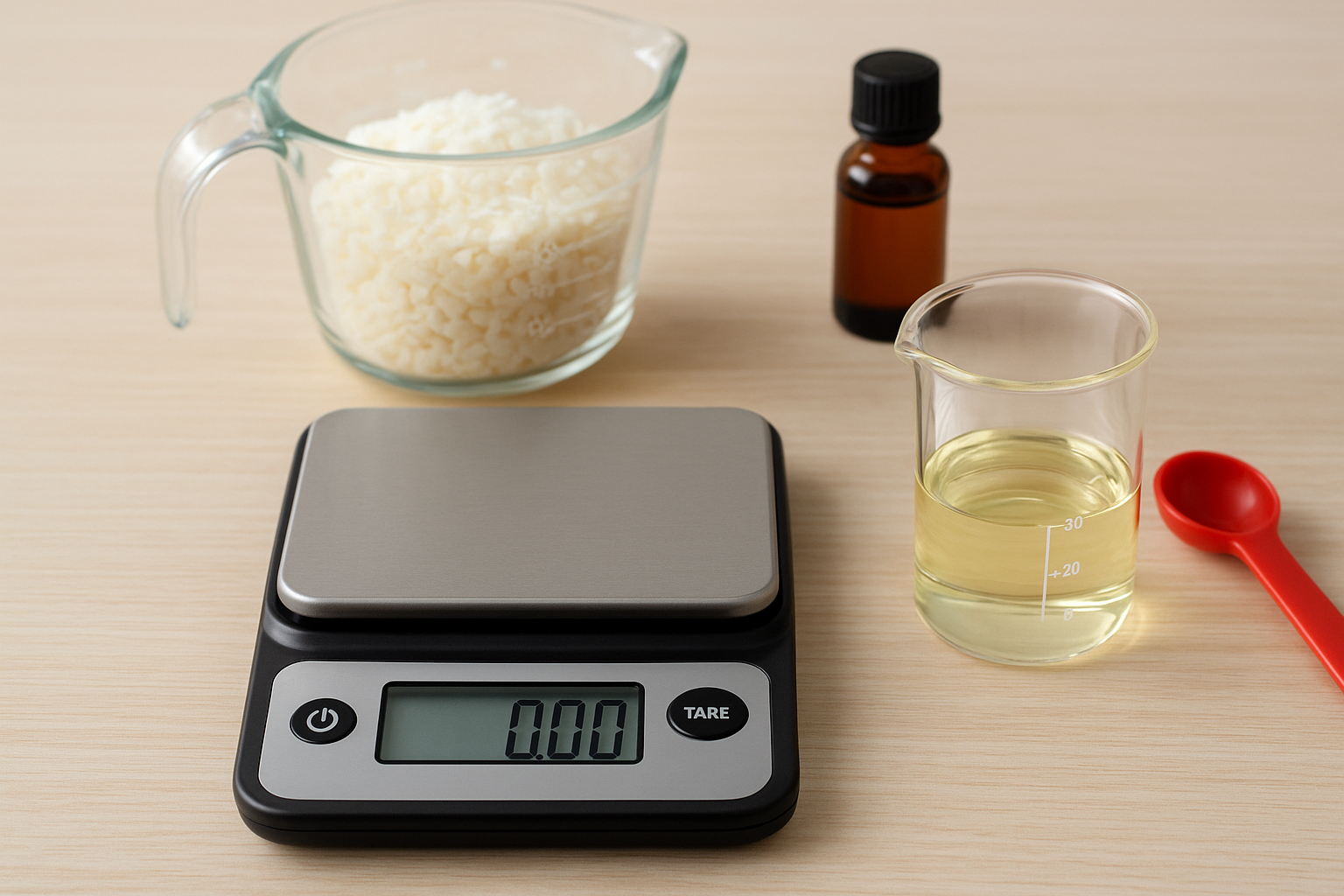
Fragrance oil (grams) = Wax weight (grams) × Fragrance load (%) / 100
For example, if you're pouring 200 grams of soy wax at an 8% load, you need 200 × 0.08 = 16 grams of fragrance oil. Here's how that formula plays out across common batch sizes:
| Wax Weight | Fragrance Load | Fragrance Oil Needed |
|---|---|---|
| 100g | 8% | 8g |
| 200g | 8% | 16g |
| 300g | 10% | 30g |
| 450g | 8% | 36g |
| 500g | 9% | 45g |
Weigh your fragrance oil in a separate container before you add it to the wax, so you can catch any measurement error while you can still correct it.
Why weight beats volume every time
Volume measurements like teaspoons or milliliters are unreliable for fragrance oils because different oils have different densities. One milliliter of a heavy, resinous scent weighs more than one milliliter of a light citrus oil, which means the same volume produces a different fragrance load depending on the specific oil you're using. A gram-accurate scale removes that variable completely.
Weigh your wax first, zero the scale, and then weigh your fragrance oil in a separate container before adding anything to the melting pot. Writing down both weights for each batch gives you a clear record to reference if your scent throw ends up weaker or stronger than expected.
Step 3. Use a quick chart for common sizes
Calculating every batch from scratch takes time, especially when you're testing multiple jar sizes at once. This chart pulls the formula from Step 2 into a ready-to-use reference so you can look up how much fragrance oil to add to soy candles for the most common container sizes without doing the math each time. The weights below assume a standard wax fill, not the total jar capacity, so make sure you're working from actual wax weight rather than the jar's listed volume.
Fragrance oil by jar size and load percentage
Use this table to find your starting fragrance oil amount. If your wax brand recommends a specific load ceiling, stick to the column that matches it rather than defaulting to the highest number.
| Jar Size | Wax Weight (approx.) | 6% Load | 8% Load | 10% Load |
|---|---|---|---|---|
| 4 oz jar | 90g | 5.4g | 7.2g | 9g |
| 8 oz jar | 180g | 10.8g | 14.4g | 18g |
| 12 oz jar | 275g | 16.5g | 22g | 27.5g |
| 16 oz jar | 365g | 21.9g | 29.2g | 36.5g |
| 32 oz jar | 730g | 43.8g | 58.4g | 73g |
These weights are starting estimates. Always weigh your actual wax fill before each batch because jar fill levels vary by brand and pour technique.
What to do when your jar size falls between these numbers
Not every jar you use will match this chart exactly, and that's fine. If your wax weight lands between two rows, apply the formula directly: multiply your exact wax weight by your target percentage and divide by 100. For example, a batch with 220 grams of wax at 8% needs 220 × 0.08 = 17.6 grams of fragrance oil. Round to the nearest half-gram and proceed.
Keeping a simple batch log where you record jar size, wax weight, fragrance load, and oil amount makes it easy to replicate good results or trace the source of scent issues in future pours.
Step 4. Add fragrance correctly and troubleshoot issues
Knowing how much fragrance oil to add to soy candles only gets you halfway there. How you add the oil matters just as much as the amount you measure out. Adding fragrance at the wrong temperature or skipping the mixing step are two of the most common reasons candles come out with weak scent throw despite having a correct load on paper.
Add fragrance at the right temperature
Most soy waxes accept fragrance oil best between 170°F and 185°F (76°C to 85°C). At this range, the wax is fluid enough to fully incorporate the oil without flash-burning the fragrance molecules, which degrades the scent before the candle even sets. Use a digital thermometer every single batch and pull your wax off heat before adding your pre-weighed fragrance oil.
Stir your fragrance oil into the wax for a full two minutes to ensure even distribution before pouring into your container.
Stir slowly and consistently using a straight-sided spatula or a stainless steel spoon. Fast or erratic stirring introduces air bubbles that cause surface cracking and pitting. After mixing, let the wax cool to your target pour temperature, which for most soy waxes falls between 135°F and 145°F, then pour steadily into your jar.
Fix weak scent throw after pouring
If your candle smells faint after curing, check these three variables before you raise your fragrance load:
- Cure time: Wait a full 48 to 72 hours after pouring before you test scent throw.
- Wick size: An undersized wick creates a small melt pool that releases little fragrance, even at 10% load.
- Add temperature: Fragrance oil added above 185°F loses potency before the wax fully sets.
Work through that list in order. Most weak throw problems trace back to one of these three causes rather than the fragrance percentage itself, so rule them out before you reformulate.
Quick recap
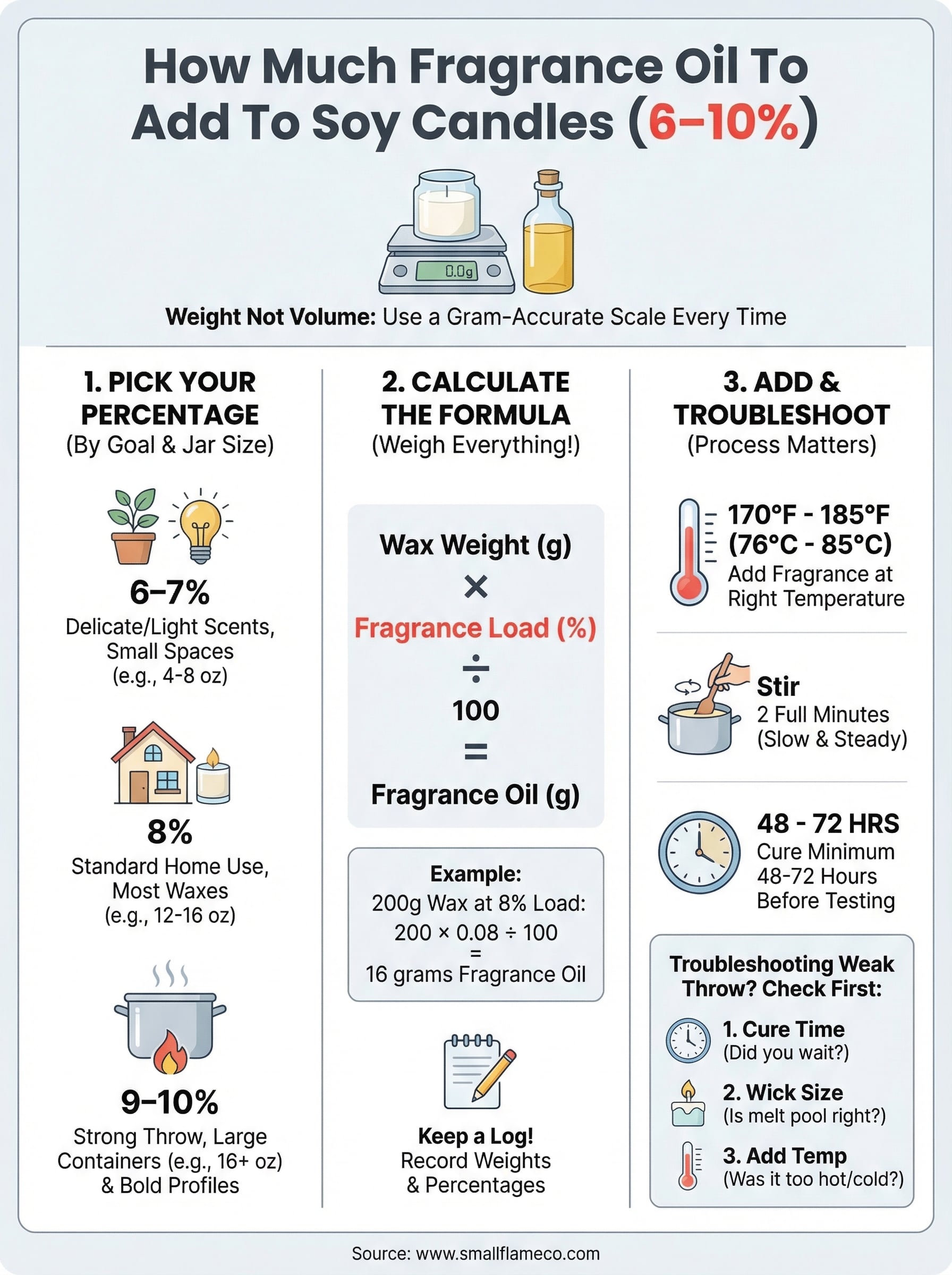
The answer to how much fragrance oil to add to soy candles comes down to 6-10% of your wax weight, measured on a gram-accurate scale every time. Start at 6-7% for lighter scents and small rooms, move up to 8% for standard home use, and push to 9-10% for bold fragrances or large containers. Multiply your wax weight by your target percentage and divide by 100 to get your exact oil amount.
Beyond the numbers, add your fragrance between 170°F and 185°F, stir for two full minutes, and give your finished candle at least 48 to 72 hours to cure before you judge the scent throw. If the throw still feels weak, check your wick size and pour temperature before you change your fragrance load.
Ready to see what a well-balanced fragrance load produces? Browse the hand-poured candles at Small Flame Candle Co. and find a scent profile that actually fills your space.