

Essential Oils vs Fragrance Oils for Candles—Which Is Best?
If you've ever shopped for candles, or tried making your own, you've probably run into the debate over essential oils vs fragrance oils for candles. One gets praised for being "natural." The other gets credit for stronger scent throw. Both have real advantages, and both have trade-offs that actually matter when it comes to how a candle performs in your home.
At Small Flame Candle Company, we hand-pour every candle we sell and have tested countless oil types across our scent library, from bakery classics to novelty favorites like Dr Pepper. That hands-on experience has given us a clear picture of how each oil type behaves in melted wax, how it throws scent into a room, and how long that fragrance holds up over a full burn.
This article breaks down the real differences between essential oils and fragrance oils, covering scent strength, safety, cost, and longevity. By the end, you'll have enough practical knowledge to choose confidently, whether you're buying candles for your living room or picking oils for a DIY candle project of your own.
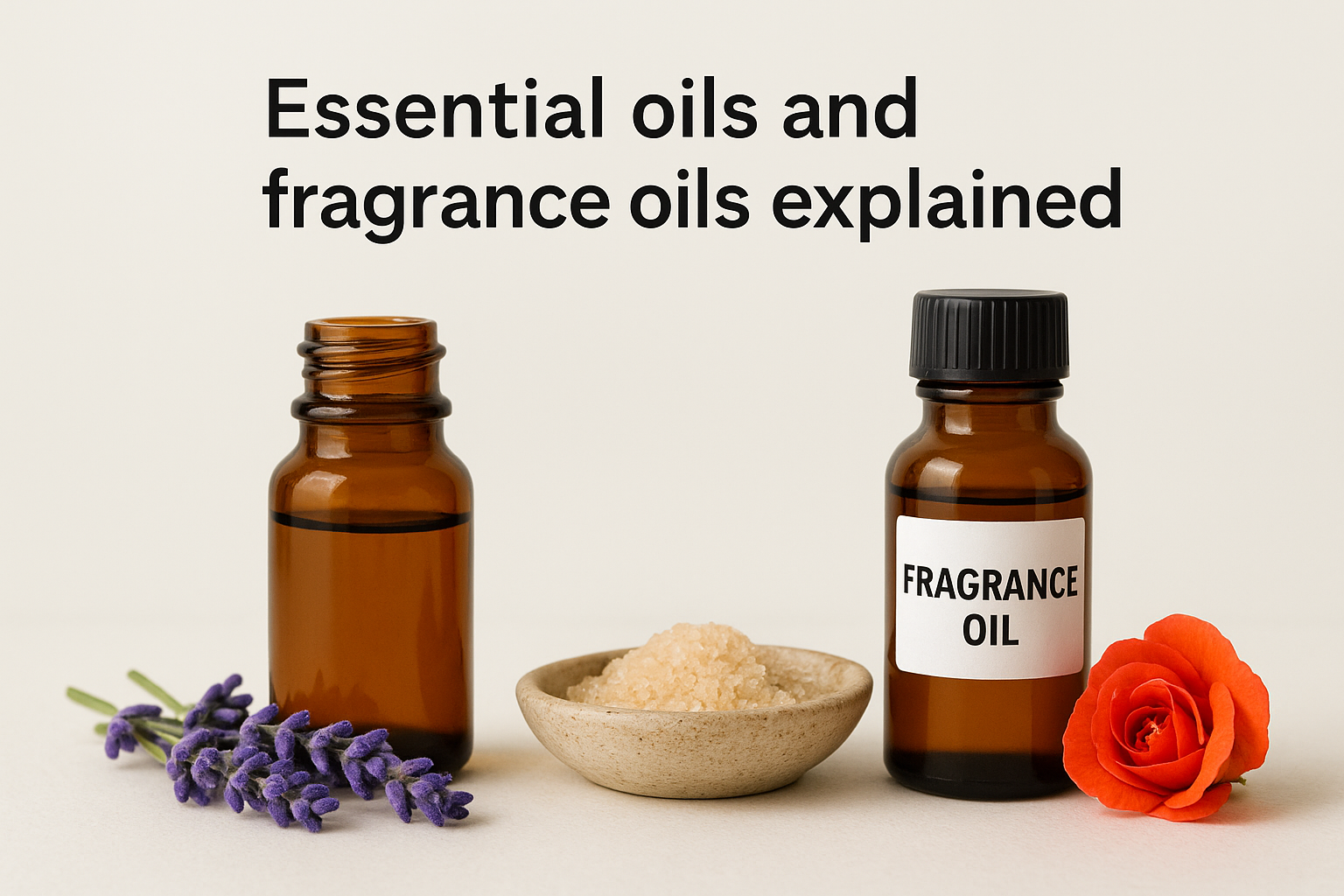
Essential oils and fragrance oils explained
When you're weighing essential oils vs fragrance oils for candles, the first step is understanding what each one actually is. These two oil types come from completely different sources, go through different production processes, and behave differently once they hit melted wax. Knowing those core differences sets up everything else, including how your candle smells, how long the scent lasts, and whether the product is safe to burn indoors.
What essential oils are
Essential oils are concentrated plant extracts pulled from flowers, leaves, bark, seeds, or roots through processes like steam distillation or cold pressing. The resulting oil carries the natural aromatic compounds of the source plant, which is why lavender essential oil smells like actual lavender rather than a synthetic version of it. Because these compounds are volatile, meaning they evaporate quickly at low temperatures, essential oils tend to fade faster in a burning candle than their synthetic counterparts.
Essential oils are 100% plant-derived, which means their scent profile is tied directly to the chemistry of the original plant, not a lab formula.
The purity of an essential oil also varies widely depending on the source and extraction method. A high-quality lavender oil from a reputable supplier will smell sharper and more accurate than a diluted one. For candle making, this inconsistency makes batch control harder, since two bottles of the same oil can perform differently in wax.
What fragrance oils are
Fragrance oils are synthetically produced or blended aromatic compounds designed to mimic a scent, whether that's a natural one like rose or something that has no plant source at all, like a baked cookie or a soda. Manufacturers create them in a lab to achieve a consistent, stable scent profile that holds up well under heat. That stability is the main reason so many candle makers, including our team, rely on fragrance oils for products meant to fill a room with a strong, lasting scent.
Your scent options also expand dramatically with fragrance oils in ways that essential oils simply cannot match. There is no Dr Pepper or Fruity Rings essential oil because those scents have no plant equivalent in nature. Fragrance oils make it possible to create a candle that smells like your favorite childhood cereal or a cold glass of soda, giving makers access to a much wider creative range than plant extracts alone allow.
Why the choice matters for candle results
The oil you choose directly shapes how your candle performs, not just how it smells before you light it. When comparing essential oils vs fragrance oils for candles, the differences show up with every burn: how quickly the scent fills a room, how long that scent holds, and how the wax behaves as it melts. Getting this right separates a candle you burn once from one you reorder every season.
Scent throw and room coverage
Scent throw describes how well a candle projects fragrance into the surrounding space, both while burning (hot throw) and before it's lit (cold throw). Fragrance oils generally outperform essential oils on both counts because their synthetic compounds are engineered to bind with wax and release steadily under heat. Essential oils contain lighter volatile compounds that burn off fast or release unevenly, leaving you with a candle that smells strongest in the first 20 minutes and fades long before the wax runs out.
Fragrance oils are formulated specifically for heat stability, which is why they tend to deliver a stronger, more consistent scent throw in finished candles.
Burn stability and longevity
Your oil choice also affects how cleanly and evenly your candle burns. Essential oils at high concentrations can interfere with the wick, causing mushrooming, uneven melt pools, or a shortened burn time overall.
Fragrance oils are tested for flash point and wax compatibility, which makes them easier to use at higher load rates without sacrificing burn quality. If you want a candle that performs reliably from the first light to the last pour, that consistency is worth factoring into your decision.
How to choose the right oil for your candles
Choosing between essential oils vs fragrance oils for candles comes down to what you actually want from the finished product. If your priority is a natural ingredient list and a soft, subtle scent presence, essential oils can work well for smaller spaces or personal-use candles. If you want strong room coverage, a wide scent selection, and reliable performance across every burn, fragrance oils are the more practical choice for most home candle applications.
Matching your oil type to your scent goal from the start saves you from reformulating batches after wasting wax.
Consider your scent goals first
Your scent goals should drive this decision before anything else does. If the fragrance you want exists as a natural plant extract, essential oils give you an authentic, true-to-source smell that some buyers actively look for on ingredient labels. If you're chasing something outside the plant world entirely, fragrance oils are your only real option because no plant equivalent exists for scents like baked desserts, fruity cereals, or novelty sodas.
Here are a few quick examples of how the choice maps to scent type:
- Plant-based scents (lavender, eucalyptus, citrus): essential oils work well
- Food, drink, or novelty scents (vanilla cake, Dr Pepper, linen): fragrance oils only
- Blended or layered profiles: fragrance oils give you the most control
Match the oil to your candle type
The size and purpose of your candle matter just as much as the scent itself. Larger candles in wide containers need an oil that binds tightly with the wax and pushes fragrance across a full room. Fragrance oils handle those higher load rates more reliably because manufacturers design them specifically for wax compatibility and heat performance.
Smaller votive or decorative candles placed in tight spaces can work well with essential oils, especially when you keep the burn time short and maintain a modest fragrance load that won't stress the wick.
Performance factors that change scent throw
Beyond the oil type itself, several other variables directly affect how much scent your candle throws. When comparing essential oils vs fragrance oils for candles, it's easy to blame a weak throw entirely on the oil, but your wax choice, fragrance load, and wick size all shape the final result just as much.
Wax type and fragrance load
Soy wax, paraffin, and coconut wax all hold fragrance differently. Paraffin generally binds fragrance oils at higher load rates, which is one reason it produces such a strong hot throw in commercial candles. Soy wax absorbs fragrance well too, but typically maxes out around 10 to 12 percent by weight before the oil pools on the surface rather than binding into the wax.
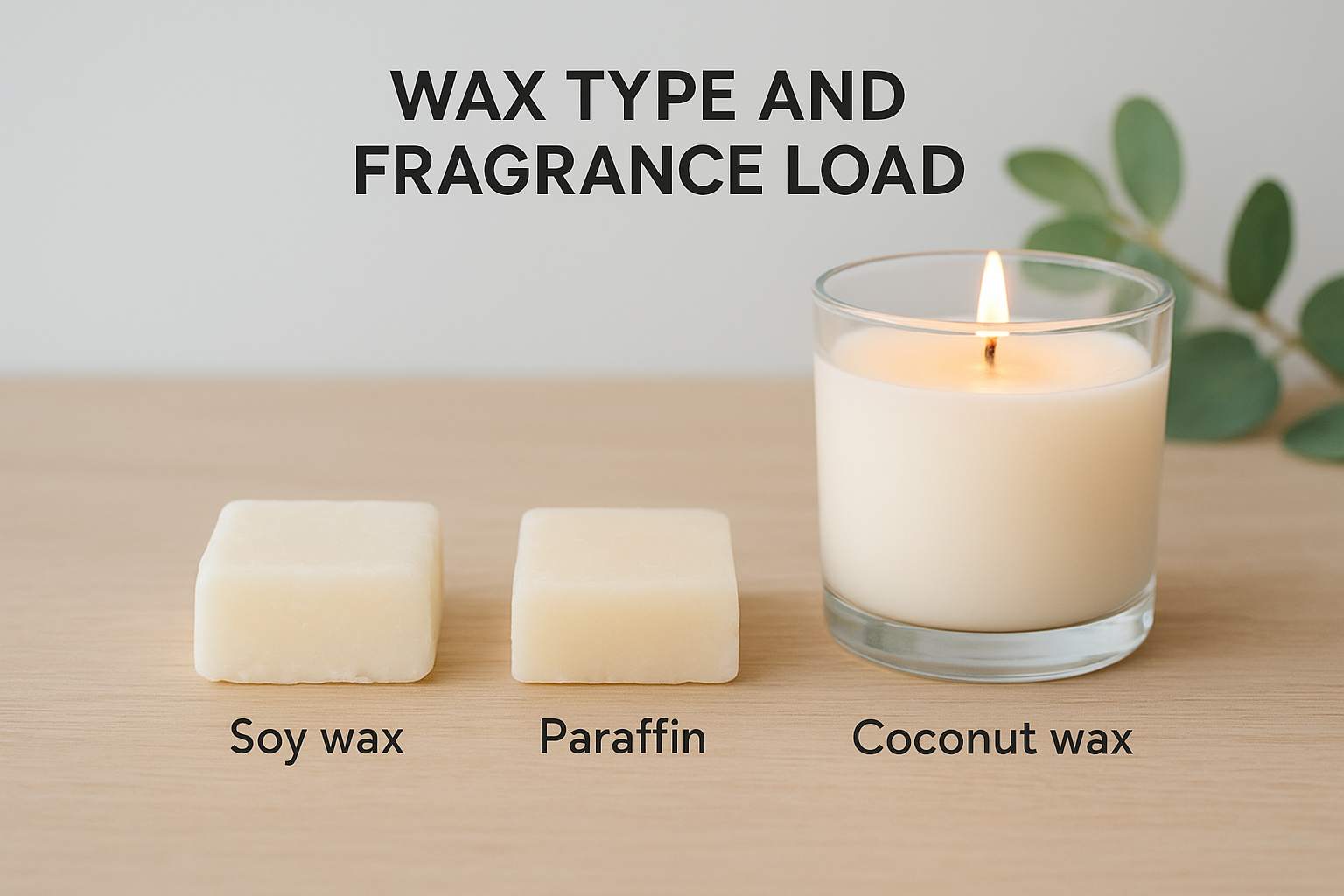
Exceeding your wax's recommended fragrance load won't automatically produce a stronger scent, it usually just causes leaching, weak adhesion, or wick problems.
Your fragrance load percentage sets a ceiling on how much scent your candle can actually release. Staying within the manufacturer's recommended range for your specific wax keeps the burn clean and the throw consistent across the full life of the candle.
Wick size and burn temperature
Wick diameter controls how hot your melt pool runs, and burn temperature directly affects how quickly fragrance compounds volatilize and travel into the room. A wick that runs too cool leaves fragrance trapped in unmelted wax along the edges. A wick that burns too hot pushes volatile compounds out of the candle before the room can absorb them.
Testing your wick size with the specific wax and oil combination you plan to use is the only reliable way to find the right balance for consistent scent performance.
Safety, labeling, and storage basics
Whether you're buying finished candles or making your own, understanding how essential oils vs fragrance oils for candles differ in terms of safety helps you use both types without unnecessary risk. Both oil types carry handling considerations that affect the people in your home and the overall quality of the finished product.
Safe handling and flash points
Every oil used in candle making carries a flash point, the temperature at which it becomes flammable near an open flame. Fragrance oils designed for candle use typically carry higher flash points than most essential oils, which means essential oils pose a greater fire risk if you add them to wax that runs too hot. Before you pour any oil into melted wax, check its flash point and keep your wax temperature clearly below it.
Adding any oil to wax above its flash point creates a fire risk regardless of whether the oil is plant-based or synthetic.
Here are two things to verify before every pour:
- The flash point of your specific oil, listed on the supplier's safety data sheet
- Your wax temperature at the exact moment you add the oil
Labeling and storing your oils
Accurate labeling on finished candles matters more than most buyers expect, especially if you give them as gifts. Some people carry sensitivities to plant compounds found in essential oils, so noting the oil type on your label gives recipients the information they need to make safe choices.
For storage, keep both oil types away from direct sunlight and heat sources, since UV exposure and warmth degrade fragrance compounds faster than almost anything else. Dark, tightly sealed glass containers protect your oils and preserve their intended scent profile between uses.
Key takeaways for better-smelling candles
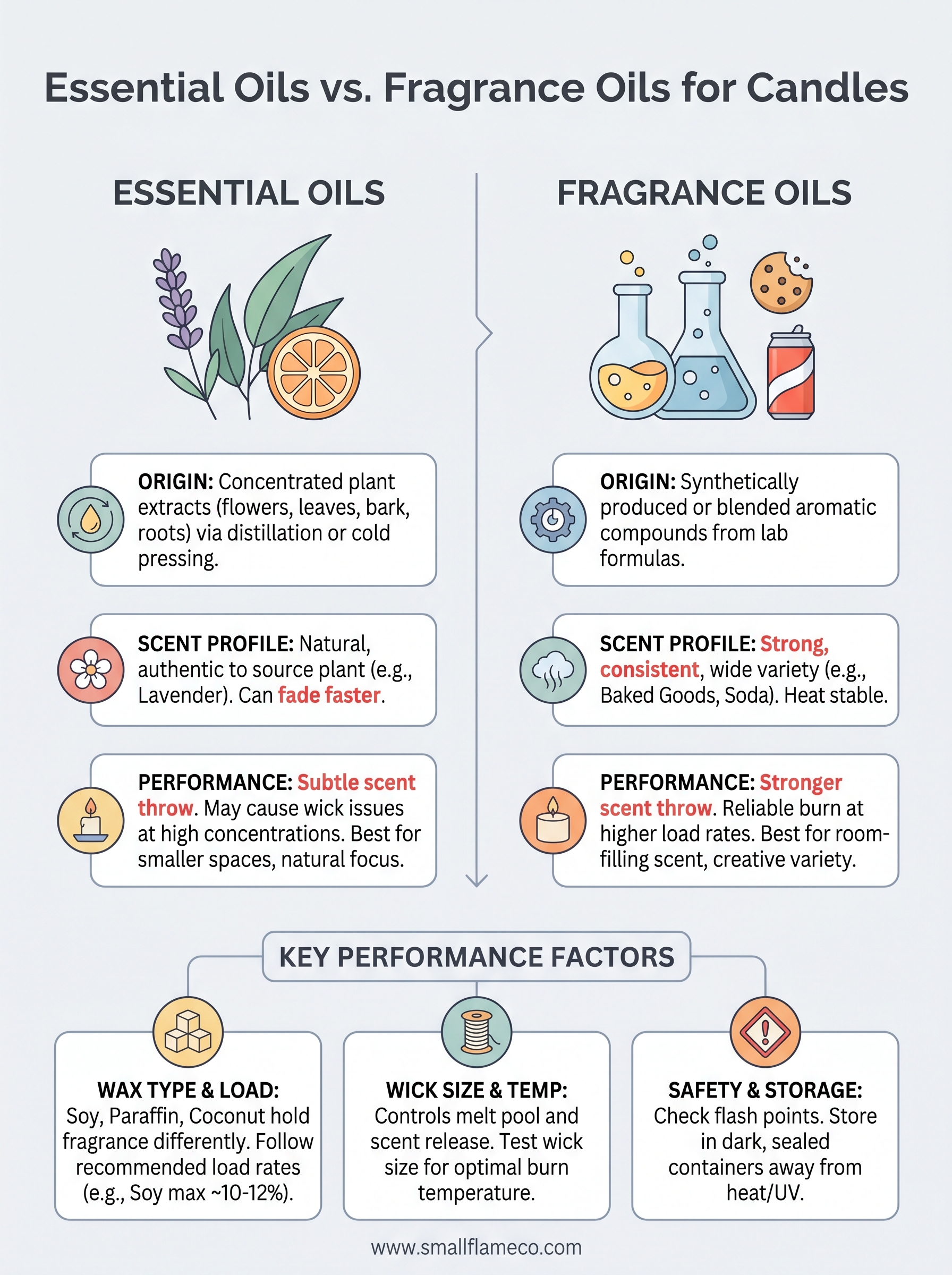
The debate over essential oils vs fragrance oils for candles does not have a single right answer, but it does have a clearer one for most situations. Fragrance oils deliver stronger scent throw, wider creative options, and more reliable burn performance across a full candle's life. Essential oils work best when you want a subtle, plant-authentic scent in a smaller space and can accept a shorter scent lifespan.
Your results also depend on factors beyond the oil itself. Wax type, fragrance load, and wick size all shape how well your candle throws scent into a room. Staying within recommended load rates and testing your wick before committing to a full batch prevents most performance problems before they start.
If you want candles already optimized for clean burning and strong scent throw, browse the Small Flame coconut wax candle collection and find a fragrance that fits your space.