

How Does a Wax Warmer Work? The Flame-Free Fragrance Basics
You drop a cube of scented wax onto a dish, flip a switch, and within minutes your entire room smells like fresh vanilla or warm cinnamon. But if you've ever paused mid-sniff and wondered how does a wax warmer work, you're not alone. It's one of those products that feels almost too simple, no wick, no open fire, just fragrance filling the air on demand.
The answer comes down to gentle, controlled heat. A wax warmer uses a heat source, a low-watt bulb, an electric heating plate, or even a tea light, to slowly melt scented wax until it releases its fragrance oils into the surrounding space. No combustion, no soot, no smoke. That's exactly why we carry a full lineup of wax warmers here at Small Flame Candle Company, from Edison bulb illumination warmers to fan-powered and decorative ArtScents models, because flame-free fragrance deserves the same attention to craft as our hand-poured candles.
This guide breaks down the actual mechanics behind each type of wax warmer, explains what makes one style different from another, and helps you figure out which setup fits your space. Whether you're brand new to wax warmers or just want to understand what's happening under the hood, you'll walk away with a clear picture of how these devices turn a small piece of wax into hours of consistent scent.
Why wax warmers exist and when they beat candles
Wax warmers didn't appear out of nowhere. They came about as a direct response to a real problem: people wanted consistent home fragrance without the risks that come with an open flame. Candles have been around for centuries, and they do the job well, but a lit wick introduces fire, soot, and smoke into your home. For anyone living in a small apartment, a space with young children, or a room with pale walls, those drawbacks add up fast. Wax warmers solved all of that by separating scent delivery from the burning process entirely.
The safety case for flame-free fragrance
The most obvious reason people switch to wax warmers is safety. A traditional candle requires an open flame that stays lit, sometimes for hours at a stretch. That means fire risk, soot deposits on walls and ceilings, and the kind of smoke that lingers in curtains and upholstery. Wax warmers eliminate all of that because no combustion ever takes place. The wax melts, the fragrance oils evaporate into the air, and when you turn the warmer off, the wax simply hardens again.
If you rent your home or share space with roommates, a wax warmer is often the only fragrance option that won't violate a lease or set off a smoke detector.
This matters practically for a lot of households. Homes with pets or small children carry a higher risk when open flames are present, and even careful candle users occasionally forget a wick burning in the next room. A wax warmer with an auto-shutoff feature or a simple on/off switch removes that concern. You get the same scent payoff without having to track a live flame.
When a wax warmer outperforms a candle
Beyond pure safety, there are several situations where a wax warmer simply does the job better than a candle. Scent control is one of the biggest. With a candle, fragrance output is tied directly to how large the melt pool is and how high the wick burns, neither of which you can adjust once the candle is lit. With a wax warmer, you control the heat source, and on many electric models you can dial the temperature up or down to change scent intensity in real time.
Cost efficiency is another factor worth considering. A single wax melt cube typically provides six to eight hours of fragrance at a fraction of the price of a comparable candle. You also don't lose wax to the burning process itself, since the wax doesn't evaporate, only the fragrance oils do. That means you can swap scents whenever you want by pouring out the used wax and dropping in a new cube, something a candle physically cannot do.
Here's a quick look at how the two options compare across the situations most people care about:
| Situation | Wax Warmer | Candle |
|---|---|---|
| Rental apartment | Works well, no smoke | Often prohibited |
| Homes with kids or pets | Safe choice | Open flame risk |
| Scent intensity control | Adjustable | Fixed to burn rate |
| Scent switching | Easy, swap wax cubes | Not possible |
| Cost per hour of fragrance | Generally lower | Generally higher |
Understanding how does a wax warmer work in the context of these practical benefits makes it clear why so many households have replaced at least some of their candles with warmers. The device isn't just a safer stand-in for a candle; it's a fundamentally different tool that gives you more control over your home's scent at any given moment.
How a wax warmer works step by step
Understanding how does a wax warmer work at a mechanical level makes the whole experience feel less like magic and more like a tool you can actually control. The process is straightforward: heat meets wax, wax melts, fragrance oils lift into the air. But there's a sequence of small events that happens between the moment you flip the switch and the moment the scent reaches you across the room.
What happens when you first turn it on
When you power on a wax warmer, the heat source activates and begins warming the dish or reservoir that holds your wax. Depending on the type of warmer you're using, that heat comes from a low-watt bulb sitting below the dish, a ceramic heating plate built into the base, or a tea light positioned underneath. The dish absorbs that heat and transfers it directly to the wax sitting on top, raising the temperature slowly and evenly.
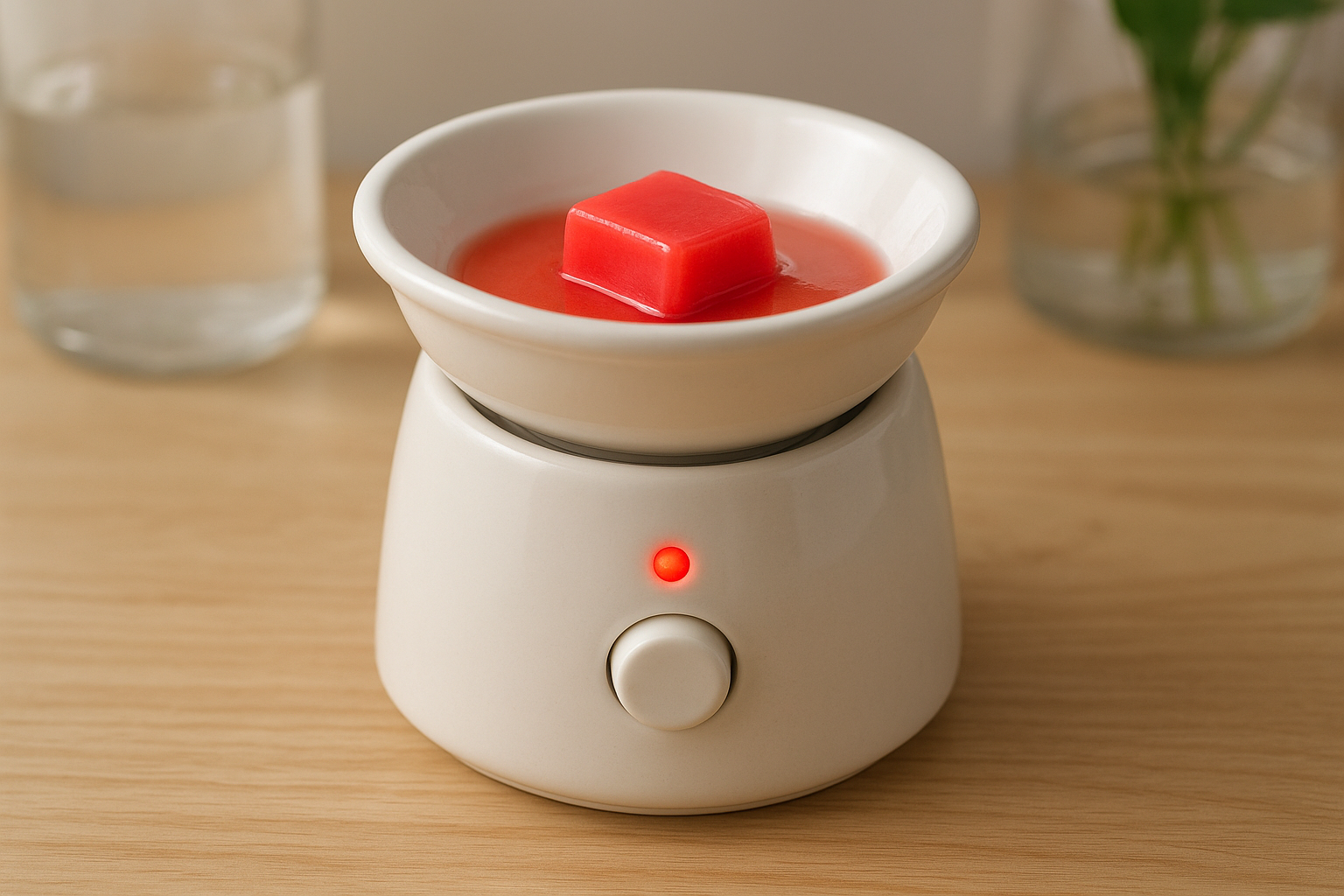
Here's the basic sequence from cold start to full scent throw:
- You place one or two wax melt cubes into the warmer dish.
- The heat source warms the dish to a low, steady temperature (typically between 120°F and 150°F).
- The wax softens, then begins to liquefy over the next few minutes.
- As the wax melts, it releases the fragrance oils suspended inside it into the surrounding air.
- The scent builds gradually until it fills the room, usually within 10 to 20 minutes.
The wax itself never burns off or disappears; only the fragrance oils evaporate, which is why the same cube eventually stops throwing scent even though wax still sits in the dish.
How the wax releases fragrance
The science behind scent release is simpler than it sounds. Fragrance oils are blended into the wax during production, and those oils have a lower evaporation point than the wax itself. When the warmer heats the wax to that sweet spot, the oils reach their volatilization threshold and start moving into the air as vapor. That vapor is what your nose detects as scent.
This is why temperature control matters. Too little heat and the oils won't fully release, leaving you with a weak or flat scent. Too much heat and the oils burn off too fast, shortening how long each cube lasts. The goal is a consistent, moderate temperature that keeps the fragrance releasing at a steady pace for hours at a time.
Types of wax warmers and heat sources
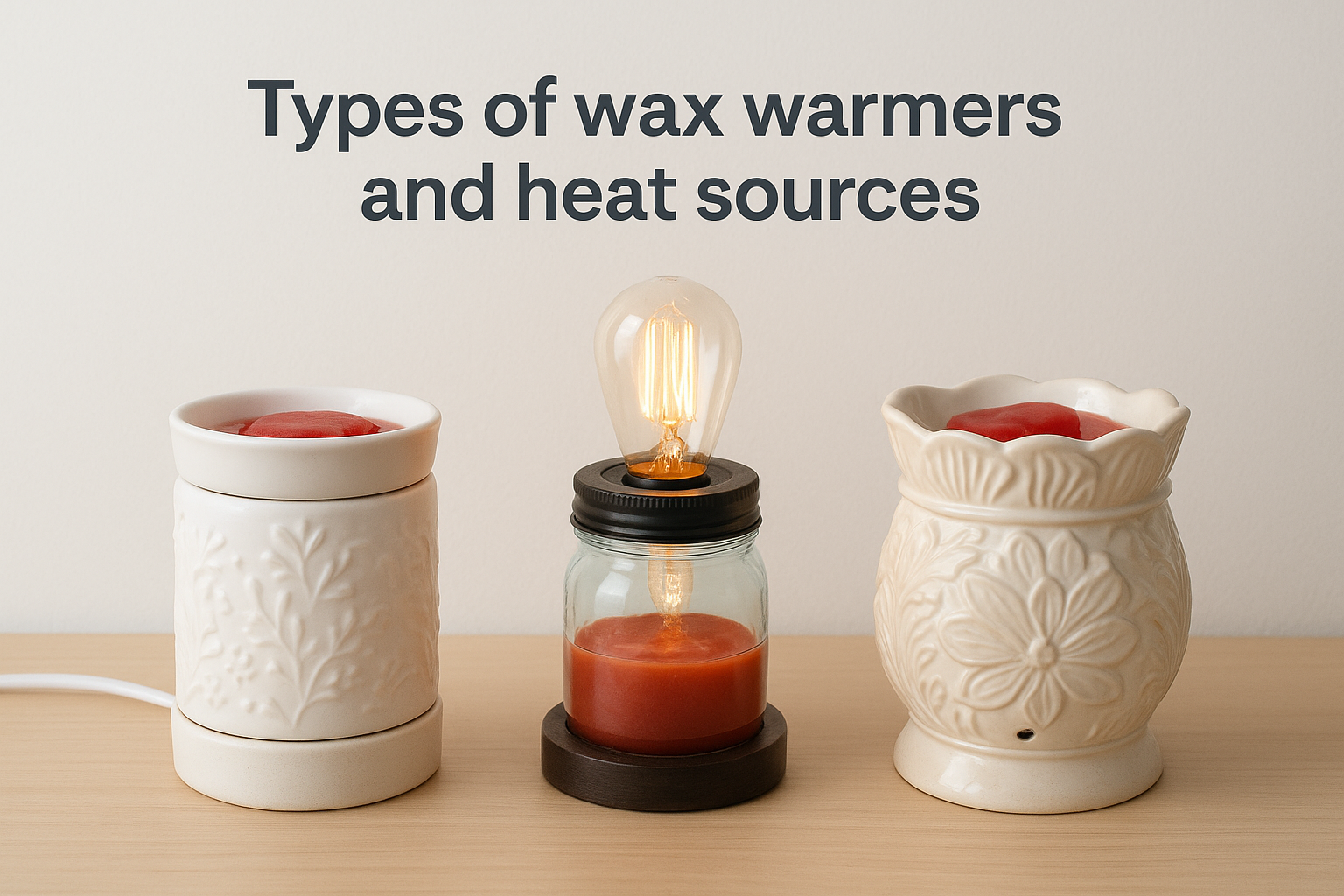
Not all wax warmers deliver heat the same way, and the heat source you choose directly affects how quickly your wax melts, how strong your scent throw gets, and how much control you have over the whole experience. Understanding the differences helps you pick the right warmer for each room in your home.
Electric plate warmers
Electric plate warmers use a ceramic or metal heating element built directly into the base of the dish. When you plug the unit in, the plate heats up and transfers that warmth straight to whatever wax sits on top. These are among the most consistent warmers available because the temperature stays steady without requiring any adjustment on your part.
Most electric plate warmers reach their target heat range within a few minutes and hold it there for hours. Your scent output stays predictable, and you have no consumables beyond the wax itself.
Bulb-based warmers
Bulb warmers heat the wax dish from below using a low-wattage light bulb, often in the 25 to 35 watt range. The heat radiates upward, warms the dish, and melts the wax gradually. These warmers double as decorative light sources, which is exactly why Edison bulb illumination warmers are such a popular option for living rooms and bedrooms where ambient light matters.
If you want one product that handles both fragrance and soft lighting, a bulb-based warmer covers both without taking up extra counter space.
Swapping the bulb lets you adjust heat output slightly, and the warm glow adds a visual element that a plain electric plate simply cannot match.
Fan warmers and decorative models
Fan warmers take a different approach entirely. Instead of heating a dish, they push a gentle airflow over a scented element to distribute fragrance into the room without any liquid wax involved. These work well in larger spaces where passive evaporation from a standard dish warmer might not carry the scent far enough.
Decorative models like ArtScents warmers prioritize aesthetics alongside function. They combine an effective heat source with detailed designs that make the warmer itself a piece of home decor. Knowing how does a wax warmer work across all these types helps you match the right device to the right space rather than defaulting to whatever's closest.
How to use a wax warmer safely
Knowing how does a wax warmer work helps you use it with confidence, but a few practical habits keep the experience both safe and enjoyable. Even though wax warmers remove open flames from the equation, they still run hot enough to cause problems if you ignore basic setup and supervision. None of these precautions are complicated, but each one prevents a specific, avoidable issue.
Place the warmer on a stable, heat-resistant surface
Your first step before plugging in is choosing the right surface. Set the warmer on something flat, firm, and heat-resistant, such as a ceramic tile, glass trivet, or solid countertop. Wooden shelves and fabric surfaces can warp or scorch over time when a heated warmer dish sits on them repeatedly, especially with bulb-based models that run for several hours at a stretch.
Also keep the warmer clear of curtains, paper, or other flammable materials that could fall against the dish while the wax is liquid. A few inches of open space on all sides is enough to avoid any contact risk.
Position your warmer somewhere it won't get knocked over by pets, children, or foot traffic near the cord.
Don't overfill the dish
Most warmer dishes hold one to two standard wax melt cubes comfortably. Adding more wax than the dish is designed for doesn't increase scent strength; it just creates a larger pool of hot liquid wax that becomes harder to manage. If that liquid spills onto the heating element or power cord, you risk damage to the unit or a genuine safety concern.
Start with one cube, let it melt fully, then judge whether the dish has room for a second. Check these basics each time you load your warmer:
- Inspect the dish for cracks before each use
- Confirm the cord sits away from the heat source
- Keep the wax fill at or below the dish rim
- Verify the surface underneath is flat and stable
Turn the warmer off before you leave
Wax warmers carry far less risk than candles, but any appliance generating sustained heat should still be switched off when you leave the house or head to bed. Many electric plate and bulb-style warmers don't include an automatic shutoff, so that step falls directly on you. If you want a more hands-off setup, pair your warmer with an inexpensive outlet timer to cut power automatically after a set number of hours.
Cleaning, replacing wax, and common problems
Keeping your wax warmer in good condition takes less effort than most people expect. Once you understand how does a wax warmer work, you also understand why regular cleaning matters: old, spent wax leaves behind residue that can mute new fragrances and gunk up the dish over time. A few minutes of maintenance after each wax swap keeps your warmer running cleanly and your scent throw sharp.
How to remove used wax
Spent wax loses its fragrance but still sits as a solid or semi-liquid in the dish. The two most reliable removal methods are the freeze method and the cotton ball method. For the freeze method, turn off the warmer, let the wax cool completely, then place the dish in the freezer for about 10 minutes. The wax contracts as it chills and pops out of the dish as a single piece with almost no mess.
For the cotton ball method, leave the warmer on and let the wax stay liquid. Drop two or three cotton balls into the melted wax and let them absorb it fully, then lift them out and discard. Wipe the dish with a dry paper towel while it's still warm to remove any thin film left behind.
Never pour liquid wax down a drain; it hardens in pipes and causes clogs.
Common problems and how to fix them
Most wax warmer issues trace back to one of three causes: weak scent, wax that won't fully melt, or a dish that discolors over time. Each has a straightforward fix once you know what to look for.
| Problem | Likely Cause | Fix |
|---|---|---|
| Weak or no scent | Wax has lost its fragrance oils | Replace with a fresh wax cube |
| Wax won't melt fully | Bulb is too low-wattage or plate isn't heating | Check bulb wattage; test outlet with another device |
| Dish discoloration | Fragrance oil residue building up | Clean dish with warm soapy water between wax changes |
| Scent smells off or chemical | Mixing incompatible scents | Empty and clean the dish before switching fragrance families |
Replacing wax at the right time makes a real difference in fragrance quality. Once a cube has been melted for six to eight hours, the oils are largely spent even if wax remains in the dish. Swapping in a fresh cube at that point gives you a clean, strong scent rather than a faint, flat one that barely registers across the room.
Quick recap and what to do next
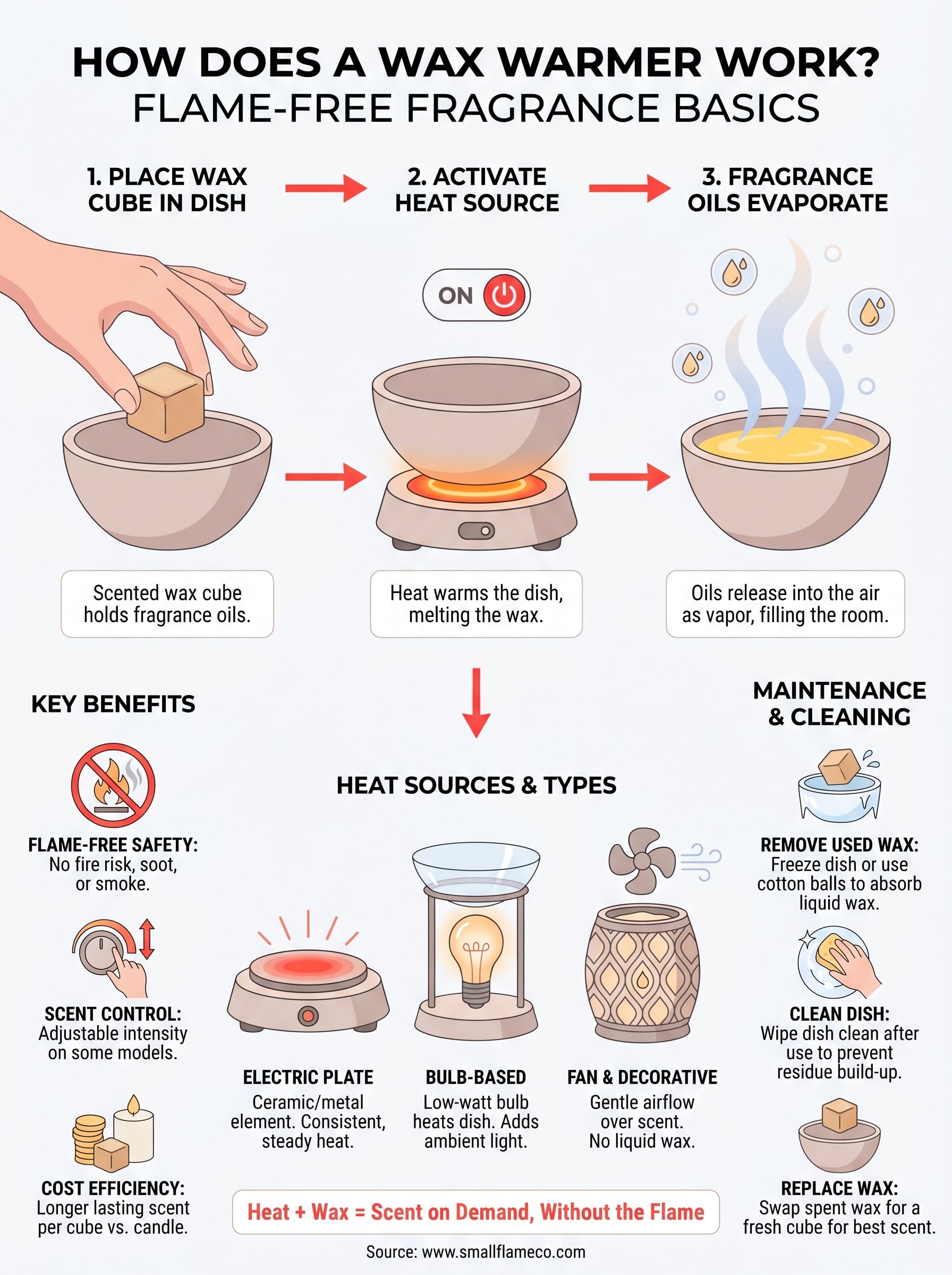
Now you have a complete picture of how does a wax warmer work: a heat source warms a dish, the wax melts, and the fragrance oils release into the air without any open flame involved. The type of heat source, whether a bulb, electric plate, or fan, determines how quickly the scent builds and how much control you have over intensity. Regular cleaning and timely wax swaps keep your warmer performing at its best for the long term.
If you're ready to put that knowledge to use, the next step is finding wax and candles worth melting. Small Flame Candle Co. hand-pours every product using a clean coconut-soy wax blend and toxin-free fragrance oils, so what you smell is what you get, every time. Browse the hand-poured coconut wax candles and wax melts and find the scents that fit your space.