

How To Calculate Candle Burn Time (With Simple Formula)
Every candle we hand-pour at Small Flame Candle Company gets tested for one thing before it ever hits our shop: how long it actually burns. Knowing how to calculate candle burn time matters whether you're a maker trying to label your products honestly or a buyer comparing value across brands. It's a straightforward number that tells you exactly what you're getting for your money.
The good news is that burn time isn't a mystery. It comes down to a simple relationship between the weight of your wax and your wick's hourly consumption rate. Once you understand that formula, you can estimate burn time for any candle, from a 4 oz tin to a 16 oz jar, with surprising accuracy.
This guide breaks the calculation into clear steps. You'll get the core formula we use, tips for testing wick consumption, and the variables that cause real-world burn times to differ from estimates. Whether you're building a candle business or just curious about how long that jar on your nightstand will last, this is everything you need to get an accurate number.
What candle burn time means and what you need
Burn time is the total number of hours a candle burns from the first light to the last flicker. It's not a rough guess or a marketing figure - it's a measurable number based on how much wax your wick consumes per hour. When you see "40-hour burn time" on a label, that number should come from a real test, not an estimate someone made up to sound impressive.
What burn time actually measures
Candle burn time reflects wax consumption over time, not just the physical size of the candle. A large candle with an oversized wick can burn through wax significantly faster than a smaller candle with a well-matched wick. The key variable here is burn rate, which tells you how many grams of wax your specific wick-and-wax combination consumes per hour under consistent, real-world conditions.
Burn time is driven by burn rate, not candle size alone - two candles of identical weight can have very different burn times based entirely on wick choice.
When you understand how to calculate candle burn time, you're tracking a straightforward ratio: total wax weight divided by hourly wax loss. That single relationship determines the number you put on your product label or use to compare candle efficiency between different formulas and containers.
What you need before you start
Before you run a single test, gather your supplies. Having everything ready in advance prevents mid-session interruptions that throw off your weight readings and give you inaccurate data.
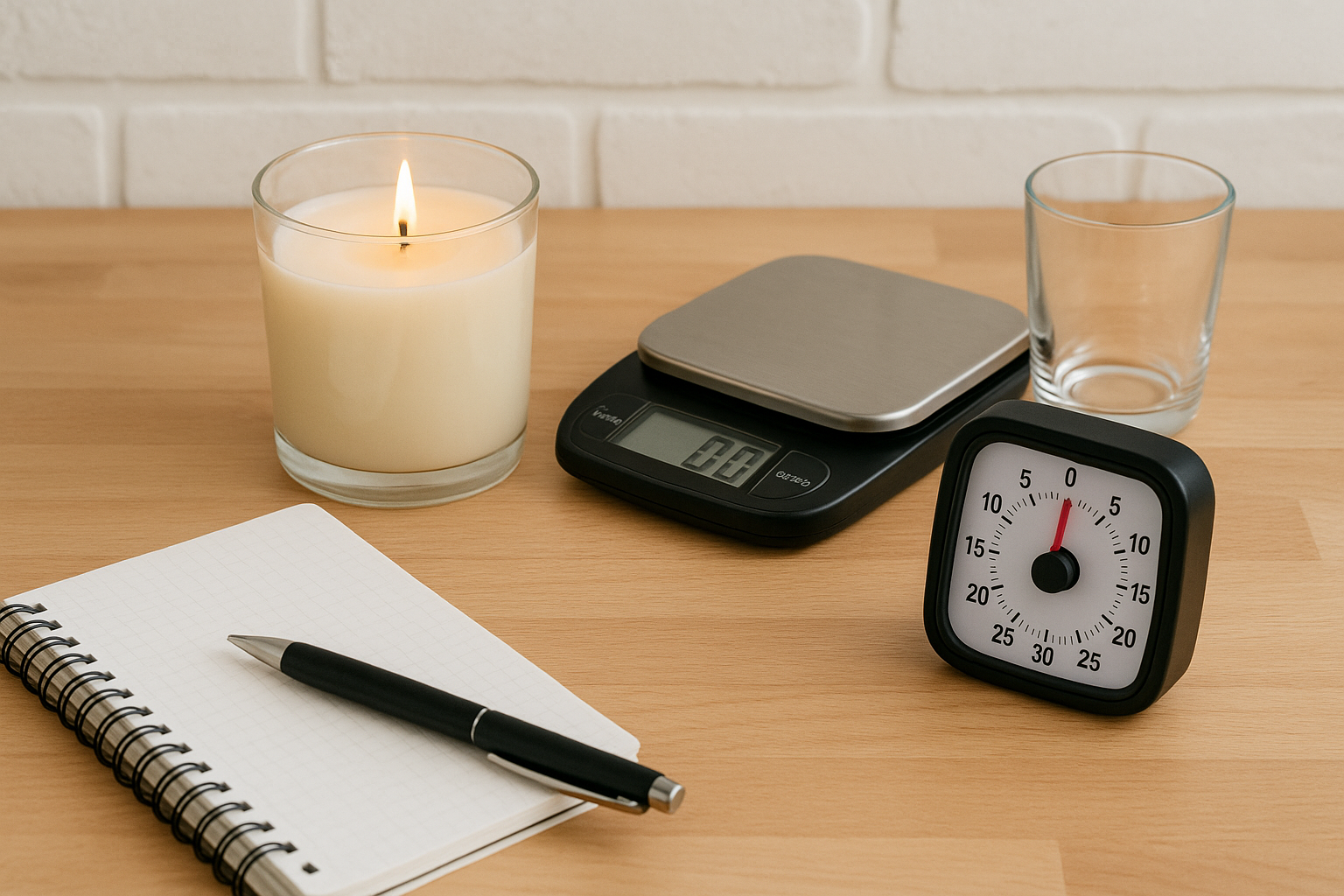
| Item | Why you need it |
|---|---|
| Digital kitchen scale (0.1g accuracy) | Captures small weight changes between burn sessions |
| A finished candle or test pour | Your actual subject for measurement |
| Timer | Tracks exact burn duration per session |
| Draft-free test space | Eliminates uneven burn caused by air movement |
| Notebook or spreadsheet | Logs before and after weights consistently |
None of this requires professional lab equipment. A basic digital kitchen scale costing under fifteen dollars handles everything you need for accurate testing. Your test environment consistency matters more than gear precision - pick one room, close the windows, and run every burn session in the same spot.
Step 1. Measure wax weight the right way
The first number you need when you want to know how to calculate candle burn time is your net wax weight, which is the weight of the wax alone, not the jar, wick, or fragrance oil. Getting this number right from the start prevents compounding errors in your final estimate.
Why you measure wax alone, not the full candle
Fragrance oil, dye, and container weight do not burn off during a burn - only the wax does. If you weigh the entire finished candle without subtracting those components, your burn time estimate will be noticeably off.
Always isolate your wax weight before any other measurement, or your final burn time calculation will be unreliable from the start.
A typical candle container adds anywhere from 1 oz to several ounces of dead weight that never feeds your flame. This matters especially when comparing burn efficiency across different container styles, where a heavier glass jar can skew your math considerably.
How to get an accurate wax weight reading
Weigh your empty container before any pouring begins and write that number down. Then weigh the finished candle after it has fully cured. Subtract the container weight and any wick tab weight from the finished total. What remains is your net wax weight.
Here is the formula for this step:
Net Wax Weight = Finished Candle Weight - Container Weight - Wick Tab Weight
For example, if your finished candle weighs 280g, your container weighs 115g, and your wick tab weighs 2g, your net wax weight is 163g. Carry that number directly into the next step.
Step 2. Run a test burn and calculate burn rate
With your net wax weight confirmed, the next step in learning how to calculate candle burn time is measuring how fast your specific wick-and-wax combination loses wax during a real burn session. This number is your burn rate, and it drives everything else in the calculation.
How to run a controlled test burn
Burn your candle in a draft-free space for a consistent time block - two hours is a reliable baseline. Before you light the wick, weigh the entire candle and write down that number. After the session ends, let the candle cool completely until the wax solidifies, then weigh it again.
The difference between those two readings is your wax consumed during that period.
Wax Consumed = Pre-Burn Weight - Post-Burn Weight
For example, if your candle weighed 280g before the burn and 267g after, you consumed 13g of wax over two hours.
How to calculate your burn rate
Your burn rate is the single most important number in the entire calculation - get this right and everything else follows naturally.
Divide your wax consumed by the number of hours burned to get your hourly burn rate.
Burn Rate (g/hr) = Wax Consumed / Hours Burned
Using the example above: 13g divided by 2 hours gives a burn rate of 6.5g per hour. Run at least two separate test sessions and average the results to smooth out any inconsistencies from your first burn before moving forward.
Step 3. Use the simple formula to estimate total hours
With your net wax weight and burn rate confirmed, you have everything you need to run the core calculation. This is where how to calculate candle burn time becomes a single, clean division problem with no guesswork involved.
The burn time formula
The formula takes your net wax weight and divides it by your hourly burn rate. The result gives you an estimated total burn time in hours, ready to place on a product label or use for a direct comparison between two different candle formulas.
Estimated Burn Time (hrs) = Net Wax Weight (g) / Burn Rate (g/hr)
This formula only produces an accurate number when you use net wax weight, not the total finished candle weight - plugging in the wrong figure here will inflate your estimate and lead to a label that overpromises.
Applying the formula to a real example
Using the numbers carried forward from the previous steps, your net wax weight is 163g and your burn rate is 6.5g per hour. Plug those directly into the formula:
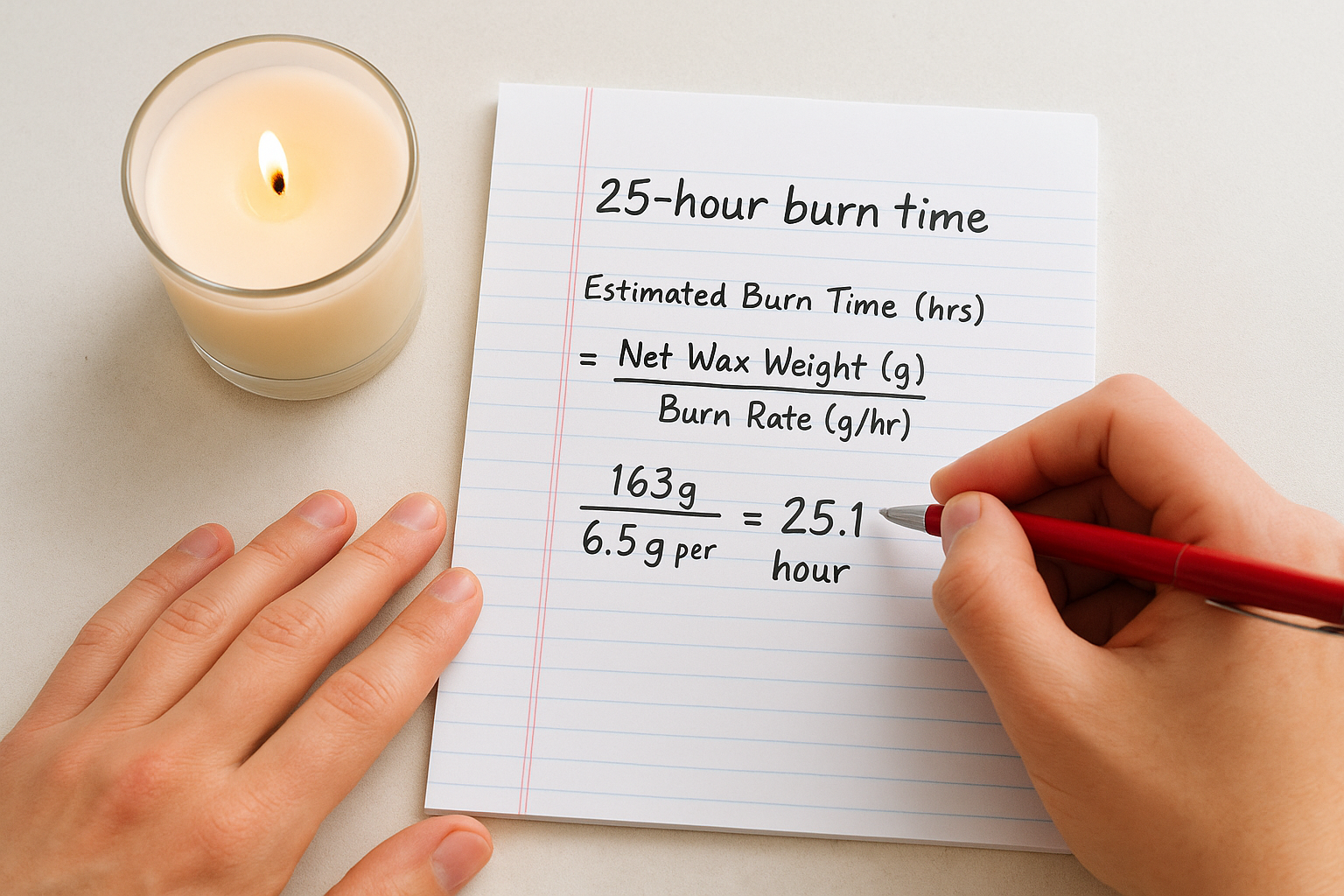
163g / 6.5g per hour = 25.1 hours
Round this candle down to a 25-hour burn time on your label. Always round down rather than up when you land on a decimal - customers burn candles under real-world conditions, and a conservative, honest label builds far more trust than an inflated number that leaves someone watching the flame die out earlier than expected.
How to sanity-check results and label burn time
A calculated estimate is a strong starting point, but real-world conditions can push your actual burn time 10-15% lower or higher than the formula predicts. Before you commit a number to your product label, run a quick sanity check against your test data to confirm the estimate holds up.
How to verify your estimate is accurate
Compare your calculated burn time against your test session data by projecting how many sessions it would take to empty the candle at your measured burn rate. If your net wax weight is 163g and your burn rate is 6.5g per hour, you should hit zero wax after roughly 25 hours of total burn time. Run three to four full sessions and check whether the wax loss per session stays consistent. A swing of more than 1g per hour between sessions signals an unstable wick or inconsistent test environment - repeat the measurement before labeling anything.
If your projected sessions don't match your real burn data within a reasonable margin, recalculate burn rate using a longer test window before moving forward.
How to write an honest burn time label
Once you understand how to calculate candle burn time and your data checks out, write your label conservatively. Use the lower bound of your tested range rather than the average.
| Label format | Example |
|---|---|
| Single hour estimate | Burn time: 25 hours |
| Range format | Burn time: 23-25 hours |
A range label gives you honest flexibility while still setting a clear expectation customers can rely on every time they light your candle.
Quick wrap-up
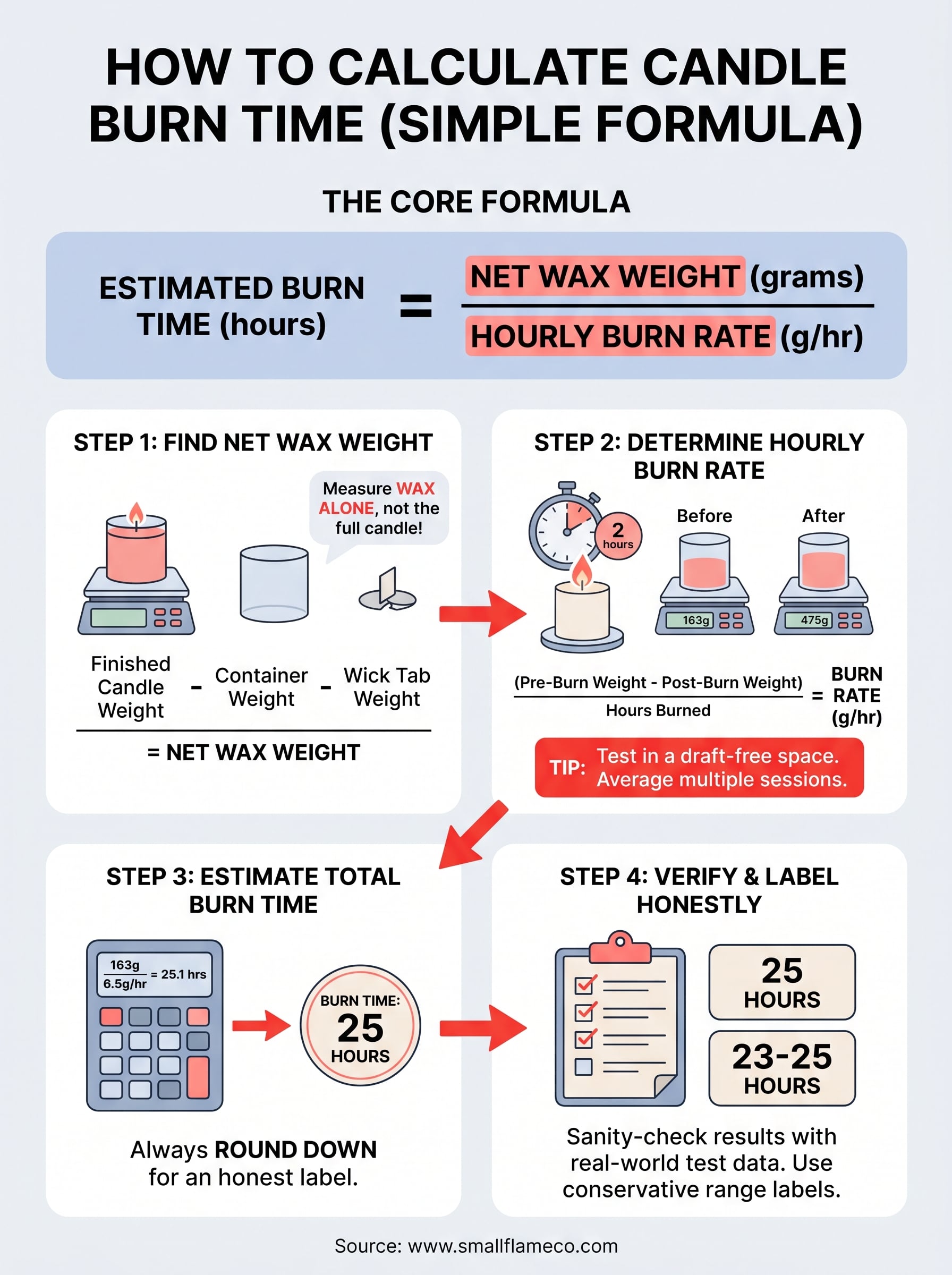
Now you know exactly how to calculate candle burn time using a method that produces reliable, label-ready numbers you can stand behind. The process breaks down into four repeatable steps: isolate your net wax weight, run a controlled test burn, calculate your hourly burn rate, and divide one by the other. When your projected sessions match your real burn data, you have a number worth printing.
Consistency drives accuracy here more than anything else. Draft-free test conditions, a well-matched wick, and conservative label rounding will protect you from the most common labeling mistakes makers run into early on. Round your final figure down, use a range when your sessions show slight variation, and re-test any time you switch wax types or container sizes.
If you want to see what clean burn performance looks like in practice, browse our hand-poured coconut wax candles and check the labeled burn times against the method you just learned.